This blog explains what white matter is and why it matters for language learning. It looks at how using more than one language may shape the brain’s communication pathways, helping different regions coordinate more efficiently.
.. status: published -->
When we talk about language learning, we often think about vocabulary, grammar, pronunciation, listening practice, and the occasional moment where your brain politely refuses to cooperate.
But language learning isn’t only about words, it’s also about connection.
And this is where white matter comes in.
White matter is sometimes described as the brain’s wiring. It matters for language learning because learning and using more than one language seems to influence how this wiring is built, strengthened, and maintained.
In other words, bilingual brains aren’t just “storing two languages.” They’re constantly coordinating, switching, selecting, inhibiting, listening, speaking, and making meaning across different networks.
That’s a lot of brain teamwork.
And teamwork needs good communication.
What Is White Matter?
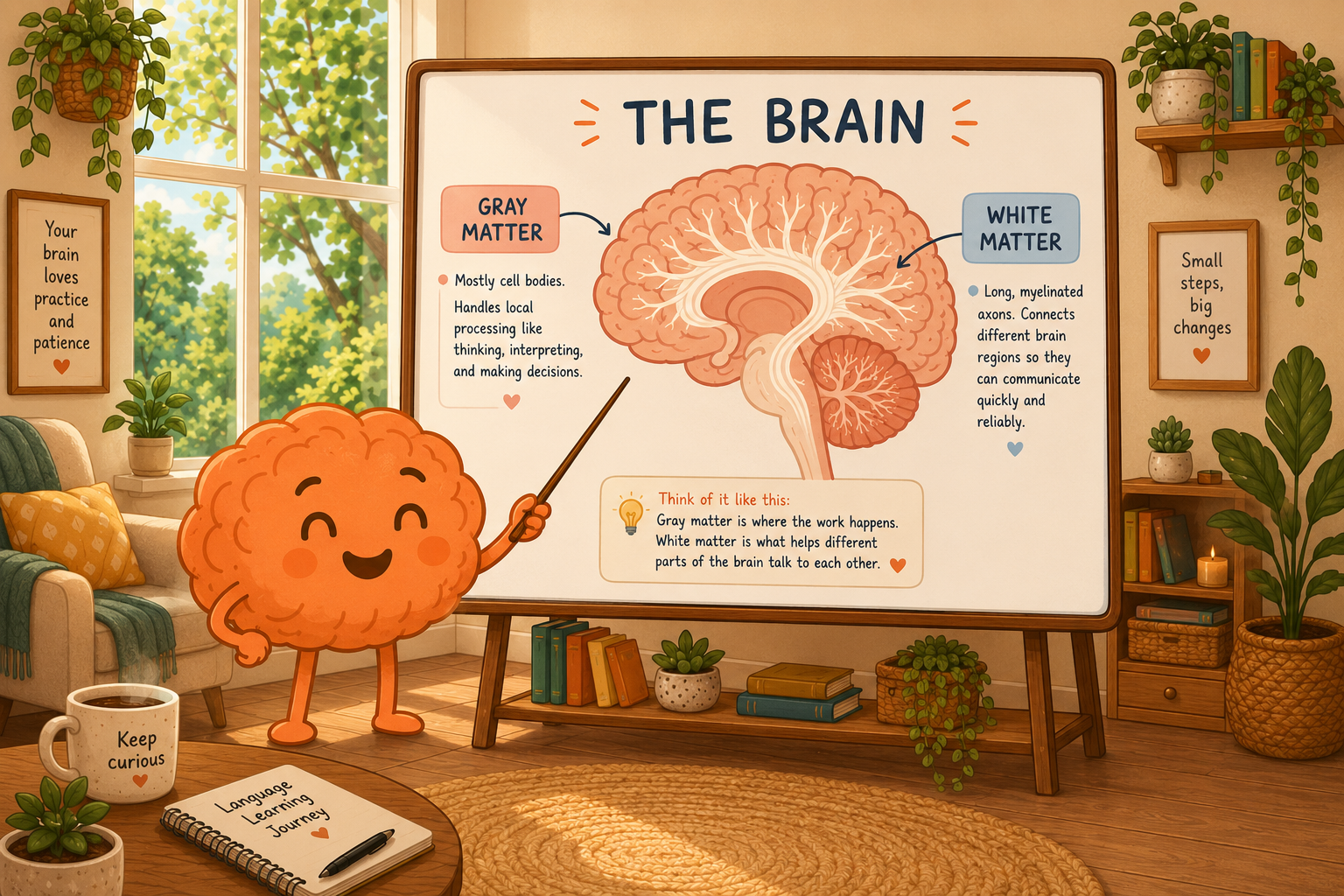
The brain is often described as having two main types of matter: gray matter and white matter.
Here’s the simple version:
| Type of brain matter | What it is | What it does |
|---|---|---|
| Gray matter | Mostly cell bodies | Handles local processing, like thinking, interpreting, and making decisions |
| White matter | Long, myelinated axons | Connects different brain regions so they can communicate quickly and reliably |
Gray matter is where a lot of the “processing” happens.
White matter is what helps different parts of the brain talk to each other.
You can think of it like this: if gray matter is the busy office where decisions are made, white matter is the phone lines, internet cables, and message routes that allow everyone to coordinate.
It’s not the part of the brain people usually talk about first, but it’s doing a lot of the behind-the-scenes work.
Why Is It Called “White” Matter?
White matter looks white because many axons are wrapped in myelin.
Myelin is a fatty insulation around nerve fibers. Its job is to help electrical signals travel faster and more reliably between different areas of the brain.
A useful way to picture it is to think of electrical wires, without insulation, the signal is slower and messier. With good insulation, the signal travels more efficiently.
That’s what myelin does for the brain.
The Brain’s White Matter Highways
Major white matter bundles are called tracts.
These tracts are like long-distance communication highways in the brain. They allow information to move from one region to another.
One of the most important white matter tracts is the corpus callosum.
The corpus callosum is the biggest white matter bundle in the brain, and it links the left and right hemispheres. It contains around 200 million axons.
So when we say your brain is making connections, we’re not being poetic. We’re being quite literal.
Why White Matter Matters for Language Learning
Using more than one language doesn’t simply activate a few isolated “language spots” in the brain.
Language is much more distributed than that.
When you use more than one language, your brain isn’t simply opening a French folder, then closing it, then opening an English folder.
Unfortunately, it’s not that clear and simple.
Our brains are hugely complex and as much as I try to simplify things — well, I ask for simplified explanations that I then relay to you — it’s never quite that simple.
Changing from one language to another means listening to sounds, preparing pronunciation, searching for meaning, choosing the right words, and sometimes politely having to ask the other language to “put a lid on it.”
In other words, many brain networks and regions have to communicate with each other. Auditory networks, motor networks, semantic networks, control networks, and both hemispheres can all be involved.
So bilingualism isn’t just extra vocabulary.
It’s extra coordination.
| Brain systems involved in language use | What they help with |
|---|---|
| Auditory networks | Hearing and processing sounds |
| Motor networks | Producing speech and pronunciation |
| Semantic networks | Understanding meaning |
| Control networks | Choosing the right language, switching, and inhibiting the other one |
| Both hemispheres | Coordinating different aspects of language processing |
So bilingual language use isn’t just “more words”, it’s repeated practice in coordination.
Your brain has to manage communication between auditory, motor, semantic, and control networks, often across both hemispheres.
That repeated use of long-distance communication may be reflected in white matter.
What Studies Suggest
Several studies have reported that bilingual people, or lifelong second-language users, show differences in certain white matter tracts.
These differences are often described as higher white matter integrity.
Some of the tracts where differences have been observed include parts of the corpus callosum and other communication pathways in the brain.
Now, let’s pause on the phrase “higher integrity,” because it sounds like your brain is being praised for its excellent values.
Not quite what neuroscientists mean, unfortunately.
In neuroscience, white matter integrity usually refers to how well organized or well maintained those pathways appear to be.
| Term | What it usually means |
|---|---|
| Higher white matter integrity | The tract may be better myelinated or more coherently organized |
| Better myelination | Signals can travel faster and more efficiently |
| More coherent organization | The pathway may support clearer, more reliable communication between regions |
So, when researchers talk about higher integrity, they’re generally talking about white matter pathways that may support faster and more efficient signaling.
And for language learners, that’s interesting because managing more than one language requires the brain to coordinate many regions again and again.
A Small But Important Nuance
This doesn’t mean we can say, “Learning a language always increases white matter.”
The brain is more complicated than that, not every study finds exactly the same pattern.
The effects can depend on several factors:
| Factor | Why it may matter |
|---|---|
| Age | The brain changes across the lifespan |
| Proficiency | Using a language more fluently may involve different patterns of brain activity |
| Age of learning | Learning early or later may affect the brain differently |
| Frequency of use | Regularly using both languages may create different demands than rarely using one of them |
So it’s safer and more accurate to say:
Bilingual experience is associated with white matter differences.
Not:
Bilingualism automatically increases white matter for everyone in the same way.
So What Are “White Matter Highways”?
When we talk about white matter highways, we’re talking about the long-distance communication cables of the brain. These pathways help different regions coordinate with each other.
And because managing more than one language places repeated demands on communication, switching, listening, speaking, meaning-making, and control, those pathways may adapt over time.
So the idea is this:
| Metaphor | What it means |
|---|---|
| White matter highways | The brain’s long-distance communication cables |
| Language traffic | The constant movement of information between brain regions during language use |
| Better coordination | Different parts of the brain may communicate more efficiently |
| Adaptation | The brain’s wiring may reflect the demands of using more than one language |
This is why language learning is so powerful: You’re not just memorizing vocabulary, you’re training your brain to communicate across networks, you’re asking different regions to cooperate, coordinate, and become more efficient together.
And every time you practice, even when it feels messy, slow, or imperfect, your brain is doing something remarkable behind the scenes: it’s building routes, strengthening connections, improving coordination.
Basically, while you’re trying to remember whether prévoir means “to plan” or “to predict,” your brain is quietly upgrading the roads.
All from regular, imperfect practice.