Love changes what captures our attention, what motivates us, and how we connect. Explore the neuroscience of romantic love, why affection and enjoyment can support language learning, and what love has to do with coaching.
“Love looks not with the eyes but with the mind.”
William Shakespeare, A Midsummer Night’s Dream
It’s February, we are getting hit with Valentine’s Day and hearts galore. While Valentine’s Day as a business opportunity might be questionable or not, a day dedicated to love, a week dedicated to love... heck, a whole month dedicated to love, why not?
Love of a person, love of a language, love of coaching, love of power, love of money. ’Tis love nevertheless. And because I spend quite a lot of time thinking about brains, languages and coaching, I started wondering what love has to do with all three.
So let’s start with the brain, move into language learning, and finish where I naturally tend to finish: coaching.
Part 1: So what’s happening in our brains when we fall in love?
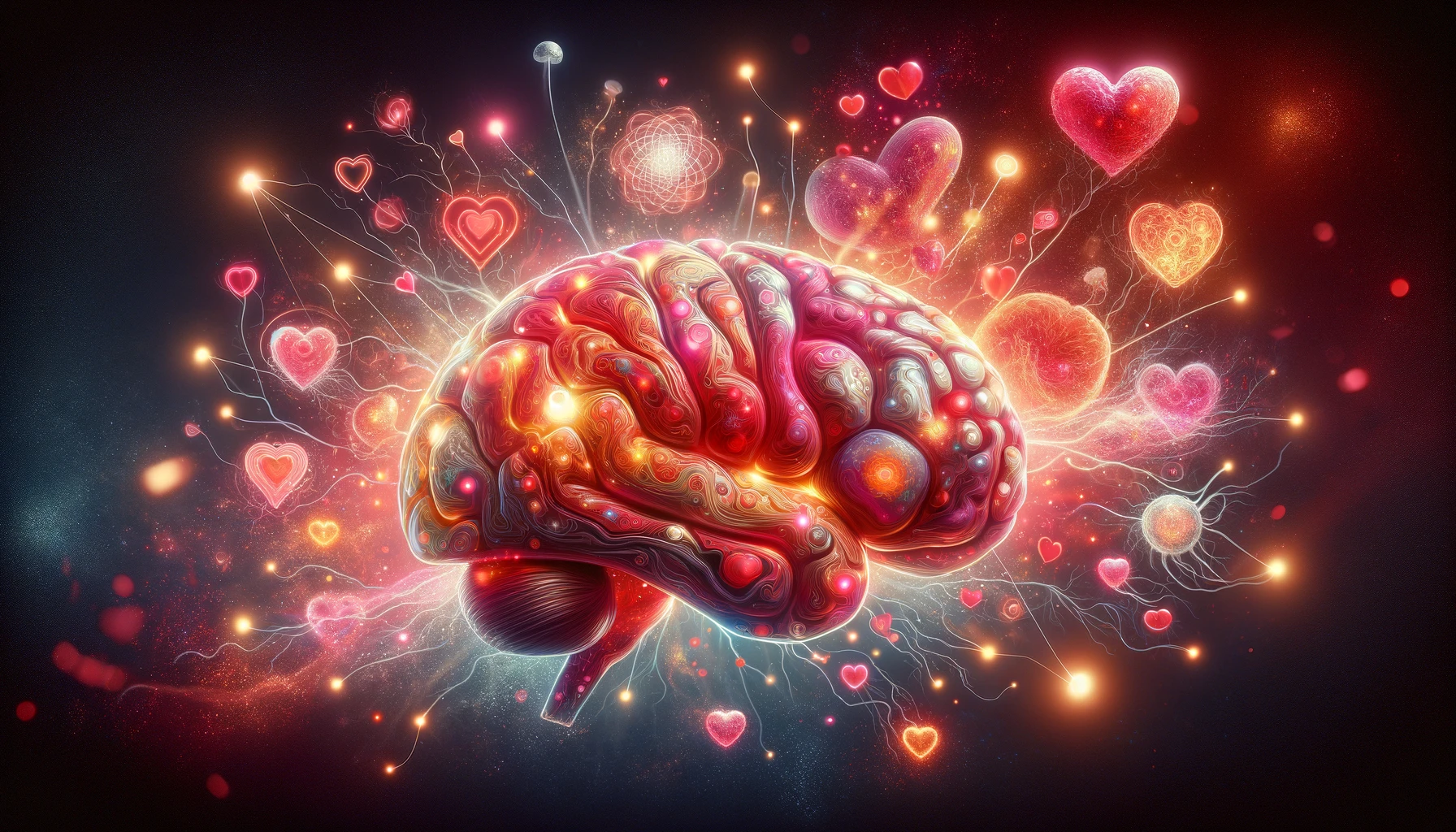
At the dawn of a romantic connection, our bodies and brains respond with a rather impressive chemical cocktail. The details are more complicated than the tidy “one chemical, one feeling” explanations we often see online, but a few systems show up again and again.
Attraction, energy and reward: adrenaline, norepinephrine and dopamine
That racing heart, the energy, the feeling that you could stay awake talking for hours? The body’s arousal systems are involved, including adrenaline and norepinephrine. They help prepare us for action and can contribute to the very physical sensations of attraction.
Dopamine is also central to the story. Brain-imaging studies of people intensely in love have found activity in dopamine-rich reward and motivation regions, including the ventral tegmental area (VTA) and caudate nucleus. In other words, romantic love recruits systems involved in wanting, motivation and reward.
You will sometimes read that falling in love is “like cocaine.” I’d be more careful. Some reward circuitry overlaps, but being in love is not neurologically equivalent to taking cocaine. Love is a much richer social, emotional and cognitive experience.
Extra brain info (because I can’t help myself): the reward system is not one little “love center.” It involves interacting regions, including the VTA, striatum, nucleus accumbens and parts of the prefrontal cortex, among others. These networks help us assign value, notice rewarding cues, stay motivated and learn from what matters to us.
Emotional highs and lows: cortisol and serotonin
Early romantic love can feel wonderful and stressful at exactly the same time. That is not a contradiction.
Cortisol is part of the body’s stress-response system, and some studies have found higher cortisol in people who have recently fallen in love. Others have found different patterns, so I would not say that love simply “raises cortisol.” What we can say is that the early stages of romantic attachment can involve real physiological arousal and stress.
Serotonin is even less tidy. Early research found differences in serotonin-related measures in people newly in love and suggested a possible link with the intrusive, slightly obsessive thinking many of us recognize from early attraction. Later studies have not produced one simple “serotonin goes down when you fall in love” rule.
Which is probably appropriate. Love has never been especially interested in tidy rules.
From passion to deeper connection: oxytocin and vasopressin
As a relationship develops, oxytocin and vasopressin are often discussed because both are involved in social behavior, attachment and bonding.
Oxytocin is released in many contexts involving social contact and physical closeness, and it can influence social reward, recognition and the salience of social information. Vasopressin is also involved in social behavior and pair bonding. Much of the strongest mechanistic evidence comes from animal research, particularly prairie voles, while the human story is more complex.
So I’m retiring the overly simple labels “cuddle hormone” and “loyalty hormone.” They are memorable, I’ll give them that, but they make two complicated neurochemical systems sound as if they have one job.
Other systems, including endorphins and endocannabinoids, may also help shape pleasure, reward and attachment.
Beyond the brain’s chemistry
While science has enriched our understanding of love, reducing love to chemical interactions would be an oversimplification of the emotional, social and psychological experience it encompasses.
Love, in its essence, remains one of life’s great mysteries. Science can tell us something about the systems involved. It cannot tell us why that person, that voice, that language, that place suddenly matters so much.
And that brings me to language.
Part 2: What does love have to do with language learning?
Have you ever wondered why loving a language can make learning it feel easier?
We don’t need a romantic partner to fall in love with a language. Sometimes, we just love the language itself. I’ve talked about my love for Spanish many times, so I know it’s true. We fall in love with how it sounds, how it works, what it tells us about its culture and history.
This passion for a language, for a person, for a culture or for a country can make the learning process more fun and positive. And when we enjoy what we are doing, we are generally more willing to pay attention, come back to it, experiment, tolerate mistakes and keep going.
That matters.
Positive emotion is not a magic memory switch, and dopamine is not a “learning chemical” that simply pours into the brain whenever we are happy. What reward and motivation systems can do is help signal that something matters. Interest, pleasure and personal relevance can support attention, motivation and engagement, all of which give learning a better chance of sticking.
You do not have to love every grammar exercise. Loving what the language lets you do is often enough.
Maybe it lets you speak to someone you care about. Maybe you want to live somewhere new. Maybe you love films, food, music, literature, travel, terrible reality TV, excellent wine, or the particular satisfaction of finally understanding a podcast without mentally translating every third word.
That personal connection can prime the brain to notice more, return more often and attach meaning to what you are learning.
A few love words in English and French
While I was contacting friends from different generations (to make sure I was up to date on different words and expressions) and searching online, I noticed something strange: there used to be a lot of different words and expressions around love. Many of them now sound old-fashioned, and they haven’t necessarily been replaced by an equally creative new crop.
Interesting.
In English, you’ll still hear babe and hon (short for honey).
In French: bébé, mon cœur, mon amour, mon chéri, ma chérie.
A couple of phrases related to love that I enjoyed translating:
- Love at first sight: le coup de foudre. Literally, a lightning strike. French clearly decided eye contact wasn’t dramatic enough.
- He’s head over heels in love with her: Il est raide dingue d’elle. Literally, something close to “stiff crazy.” Romance!
- Soulmate: âme sœur. Literally, “sister soul,” even if it’s a guy, because âme is feminine in French.
- Un cœur d’artichaut: literally, “an artichoke heart.” Someone with un cœur d’artichaut falls in love easily, quickly and therefore... often.
- Il est au septième ciel: he’s on cloud nine.
And a few useful things about French and “to love”
French does have ways to express “like,” of course, but it does not map neatly onto English.
J’aime bien usually means “I like.” That little bien often softens aimer.
J’aime can mean “I like” or “I love,” depending on what or whom you are talking about and the context.
And j’adore is used all the time for things you really love, without implying romantic love.
J’adore les newsletters de Feriel. - I love Feriel’s newsletters (an entirely objective example ;-)
Learn through what you already love
Love songs are an obvious playground for language learning. Lyrics give you repetition, emotion, memorable phrases and a cultural window, all wrapped in something you may actually feel like listening to again.
I made French and English love-song playlists for exactly that reason. I can’t say I love every song I added, but I tried to include different styles from roughly the past fifty years.
The broader principle is simple: bring more of what you already enjoy into the language. Your playlist. Your podcasts. Your Netflix series. The restaurant menu you keep pretending you understand. Your favorite subject at work. The person you want to talk to.
Learning becomes much easier to inhabit when the language belongs to your life rather than sitting outside it as another task.
Part 3: What’s love gotta do with coaching?
What’s love gotta do with it, you may ask? Everything. From my LOVE of coaching, of languages and neuroscience, to growing your LOVE of communicating in a new language, to fostering a form of LOVE for others when communicating together in a common language, to self-discovery and self-LOVE.
Tina Turner kept asking (The lyrics are in the video, so you can call it language practice).
My love of brain-based coaching
When I started my initial Neurolanguage Coaching journey, I hadn’t realized that not only would I fall in love with coaching, but I would also reconnect with a long-lost love.
In advanced biology in high school, we dissected a frog and observed something about its brain and its heart. I don’t remember the details, but I do remember learning incredible things about the brain and loving it. I even thought that I’d study it when I went to college.
Life happened.
Fast forward a few decades and here I am rediscovering a forgotten passion and blending the science of the brain (well, a little, but still) with the art of language learning.
How does that love for coaching and for neuroscience translate in real life?
I’ve taken several coaching courses, laying the groundwork towards achieving my ICF certification: Neurolanguage Coaching (Initial, Advanced and Professional) and a Brain-Based Coaching Certificate.
Additionally, my fascination with how the brain learns languages led me to learn more about the brain through a few courses on Coursera: Synapses, Neurons and Brains, Neurolinguistics, Understanding the Brain: The Neurobiology of Everyday Life, and Learning How to Learn: Powerful Mental Tools to Help You Master Tough Subjects.
Sparking love for languages with coaching
Language coaching goes beyond teaching. It’s about crafting a custom-made language-learning journey that’s as unique as you are, triggering aha! moments by connecting with what you love.
It’s pretty great to see the spark light up when someone starts to dig into a new language, transforming that I-gotta-do-this vibe into I-really-want-to!
That’s the magic of coaching. It’s not just study time, it’s discovery time.
It’s essential to remember that loving a language means enjoying the learning process and feeling happy to engage with it. Enjoyment and positive emotion can support attention, motivation and engagement, which in turn can help learning and memory.
But you already knew that ;-)
Language coaching as a means to connect cultures through love
At the heart of language learning lies the potential to bridge worlds, connecting diverse cultures through the power of communication and a shared love for understanding.
This isn’t about a simplistic notion of “let’s all love each other,” but rather developing a profound appreciation for the richness of different cultures.
Growing up in a multicultural family and living across three continents, I’ve experienced firsthand the power of language in connecting cultures. This personal journey has deeply influenced my coaching, underlining the importance of developing a love for cultural understanding when learning a language.
Language learning: a path to self-love and confidence
Ah! Confidence! The secret to unlocking your language speaking, your mindset about a language, your relationship with that language and so much more.
Language learning is a journey towards self-love, confidence and overcoming biases. It challenges us to step out of our comfort zones, face our preconceptions and embrace growth.
We get a sense of accomplishment, build resilience and enhance our self-esteem. As a coach, I support learners in viewing each challenge as an opportunity, not just for linguistic improvement but for personal transformation.
What are you waiting for?
Love may not be the whole answer, but it changes the question
Love is not a study technique.
It will not conjugate verbs for you, remember vocabulary on your behalf or magically make speaking effortless.
It can, however, change what you pay attention to, what you return to, how much meaning the language carries and how willing you are to stay with the uncomfortable parts of learning.
My own path brought together several kinds of love I didn’t expect to meet in the same place: languages, the brain, coaching, cultural connection and that peculiar pleasure of watching someone realize, Wait. I can actually do this.
Maybe the most useful question isn’t How can I force myself to learn this language?
Maybe it’s What would help me build a relationship with this language that I actually want to keep?
If you’d like to explore this with a coach, contact me for a discovery session.