Language learning depends on more than motivation. Explore how habits form in the brain, why consistency and spaced repetition matter, and how coaching can help you build habits that fit your real life and actually stick.
“We are what we repeatedly do. Excellence, then, is not an act, but a habit.”
— Will Durant, summarizing Aristotle
I’m digging and digging. Deeper and deeper into the brain. When I started looking at habits, I got all the way into the basal ganglia and, more precisely, the striatum.
Your habits, good or bad, or lack thereof, have a lot to do with what happens there. And when you learn a language, habits become particularly interesting because two things are inevitable: consistency and repetition.
Motivation can get you started. It is much less reliable at 8:00 on a rainy Tuesday morning when you have five minutes before work and your English is not exactly calling your name.
That is where habits come in.
Part 1: What happens in your brain when a habit forms?
What are habits, and why do we have them?
Habits are actions or behaviors that we perform repeatedly and, with enough practice in a stable context, often with less conscious thought or effort.
That matters because your brain has a lot to do. If you had to actively decide how to tie your shoelaces, brush your teeth, make coffee, unlock your phone, or drive the familiar route home every single time, you would use attention on things that no longer need much deliberation.
In classic diary research, people performed a substantial proportion of their everyday behaviors repeatedly in similar contexts. The often-quoted “around 40%” figure comes from this kind of research, not from the idea that exactly 40% of everything every person does is hardwired habit.
Habits reduce the mental work required for familiar actions. They free attention for the rest of your day, which is useful because there are usually more critical matters than remembering which foot goes into which sock.
Repeated behavior also changes the brain. Neural connections involved in a frequently practiced action can strengthen and reorganize with experience. This ability to adapt is part of neuroplasticity.
I use the word rewire in coaching because it gives us a useful image, but the brain is not an electrical panel where we simply move one cable from A to B. Plasticity is ongoing, distributed, and far more complex than that.
The basal ganglia, the striatum, and automatic behavior
To understand habits, we need to look at a network of structures deep in the brain called the basal ganglia. They contribute to movement, action selection, learning, reward-related processing, and the development of automatic behavior.
One of their major structures is the striatum. It receives extensive input from the cortex, including areas involved in planning and decision-making, and it plays an important role in learning which actions tend to follow which cues and outcomes.
The older, very neat story said that a new behavior begins under conscious control in the prefrontal cortex and then, once it becomes a habit, control simply shifts to the striatum.
The real picture is less tidy (brains have a habit of ruining our tidy explanations).
Research suggests that different parts of the striatum contribute at different stages of learning, while cortical networks continue to matter as behavior becomes more automatic. There is no little switch marked PFC OFF / STRIATUM ON. Habit formation reflects changes across connected brain systems.
So what does dopamine do?
Dopamine is also involved, although not quite in the “dopamine equals pleasure” way it is often described online.
When an outcome is better, worse, or different from what the brain predicted, dopamine signaling can help update learning. In corticostriatal circuits, dopamine contributes to reinforcement, motivation, and learning which cues and actions are worth repeating.
So when a behavior regularly leads to an outcome your brain values, the cue, action, and outcome can become increasingly linked.
That does not mean every habit gives you a happy little dopamine shower. It means dopamine is one part of the machinery your brain uses to learn from rewards, expectations, and experience.
And this matters because the more you understand that your brain is malleable and adaptable, the more room you have to work with your behavior rather than treating it as fixed.
Of course, the mechanism is much more complex than this. Research on habits is still active, and habits overlap with, but are not the same as, compulsions or addictions. Still, even this basic framework can help you make more intentional choices.
The cue, craving, response, reward loop
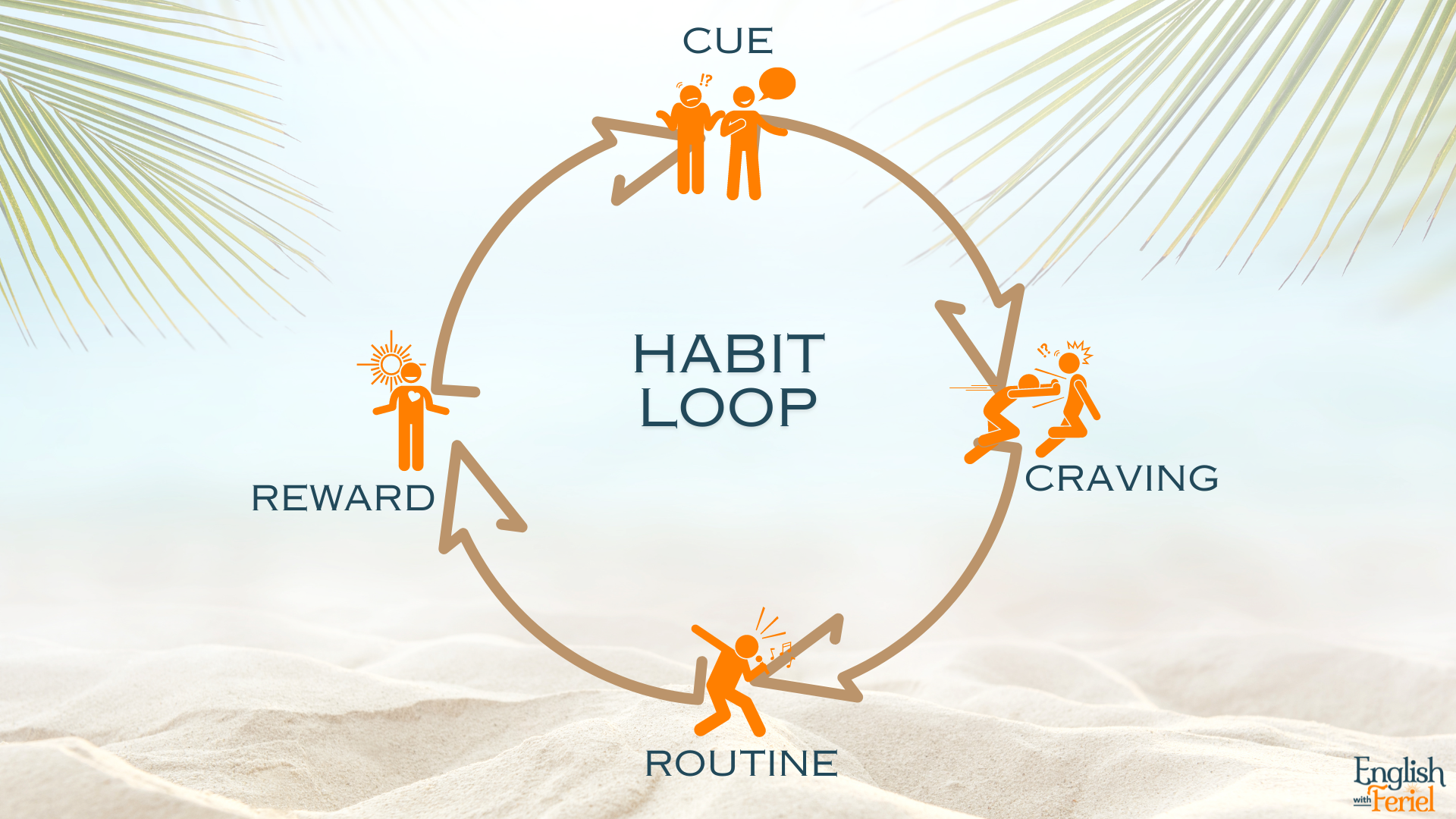
A practical way to think about habit formation is the four-step loop popularized by James Clear:
Cue: something triggers the possibility of a behavior. It might be a time of day, a location, a smell, a person, a sound, an emotional state, or an event.
Craving: you want a change in state. Relief, stimulation, connection, progress, calm, novelty.
Response: the behavior itself.
Reward: the outcome that makes the behavior worth remembering and, possibly, repeating.
Take a workplace example.
Your boss speaks badly to you.
Your first craving may be to tell him to shut up (or worse).
Instead, your response is to go to the gym and beat up a punching bag.
The reward? You get it out of your system, calm down, and have a much better evening.
The phone example is even more familiar. You see your phone lying nearby. That is the cue. You want novelty, information, or connection. You pick it up and start scrolling. Sometimes there is something interesting, sometimes not, and that unpredictability can make checking especially sticky.
This is not proof that your phone has hijacked a single “pleasure center.” It is a learned loop involving cues, expectations, attention, and reward.
Once you understand the loop, you can start using the same logic on purpose.
Which brings me to language learning.
Part 2: Habits, consistency, and language learning
There are many dimensions to language learning, but two things are difficult to escape: consistency and repetition.
No matter how you prefer to learn, reading, watching TV shows, listening, doing exercises, speaking, or mixing several activities, you need repeated contact with the language. There is no way around it.
A habit gives that repetition somewhere to live in your day.
Start with a cue that already exists
You do not always need to invent a whole new schedule. Sometimes the easiest cue is something that already happens.
Imagine another meeting in English where nobody makes much effort to help you follow, and you are too shy to speak up.
Cue: the meeting ends and you leave frustrated.
Craving: you want to progress in English and get that frustration out of your system.
Response: you put your headphones on and listen to a song in English on your way home, singing along when you can.
Reward: you pick up words and expressions, and you arrive home more relaxed thanks to the magic of music.
You have attached a small language-learning behavior to something that was already happening.
You can also decide what your cue will be.
Cue: you set an alarm for 8:00 every morning (and make yourself a coffee).
Craving: you want to take an active part in meetings in English.
Response: you spend five minutes working on your English.
Reward: you expand your vocabulary, strengthen what you already know, and maybe even impress a few people in the next meeting.
Five minutes does not sound spectacular. That is rather the point.
A realistic habit does not need to look impressive on Instagram. It needs to be repeatable in your actual life.
Consistency is the real engine
Consistency is the real engine propelling you forward in your language journey.
Establishing a habit, even a single five-minute practice a day, gives consistency a structure. With repetition, you reinforce the knowledge and skills you keep activating.
The magic of consistency is not that effort suddenly disappears. It is that repeated effort becomes more familiar. What once required a lot of attention can start to feel easier to access, and the language begins to inhabit more of your everyday life.
That might mean you stop negotiating with yourself about whether you are “doing English today.” The cue arrives, you do the thing, and you move on.
This is where a small habit can beat a heroic study session once every three weeks.
Spaced learning: repetition with breathing room
Spaced learning fits beautifully with this.
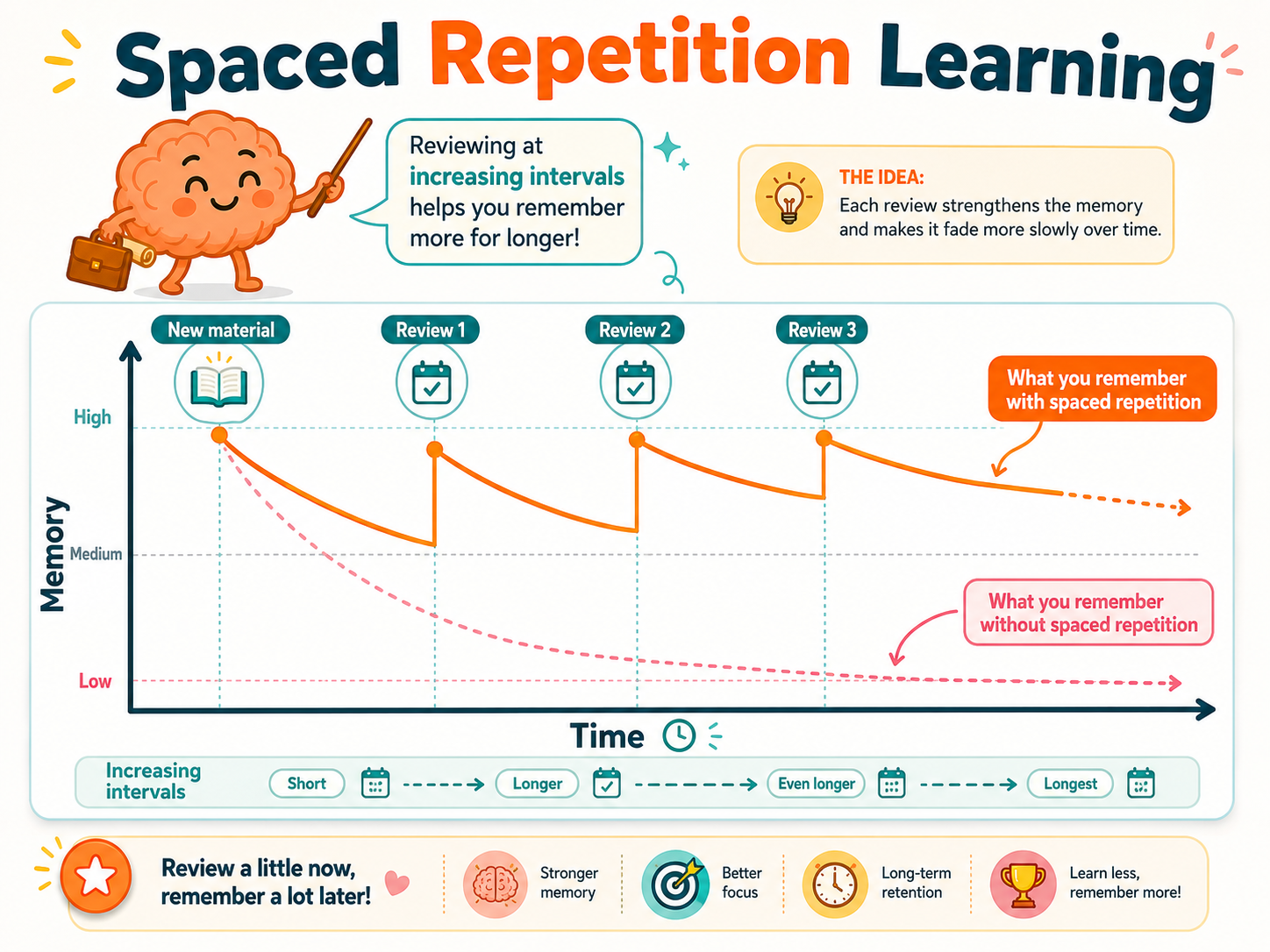
The basic idea is simple: instead of cramming the same information into one session, you come back to it across time. Research on the spacing effect consistently shows that repetitions spread out over time tend to support longer-lasting retention better than repetitions packed closely together.
So a word you meet today can reappear tomorrow, then a few days later, then later again. The intervals do not have to be perfect. The important part is that retrieval and review happen more than once, with some space between them.
Many language apps build this principle into their review systems. You do not need an app, though. A notebook, flashcards, a recurring five-minute slot, or words collected from your own meetings can do the job.
Repetition is not the boring part of language learning. Mindless repetition is. Repeated contact with useful language, at sensible intervals and in changing contexts, helps knowledge become easier to retrieve when you actually need it.
And that is the point. You are not learning English to win a flashcard competition. You are learning it so that the right words have a better chance of showing up when someone turns to you in a meeting.
Part 3: Habits, routines, and coaching
Before going further, a word about habit and routine, because I use both and they are not quite the same thing.
A habit is relatively automatic. You do it with little deliberation once the cue appears.
A routine requires more organization and can contain several habits.
When you reach for your phone and scroll through Instagram without much thought, that can be a habit. It can also sit inside a larger routine: wake up, shower, coffee, Instagram, subway, work, subway, dinner, Netflix, sleep.
The words habit and routine can evoke repetition, boredom, and resistance to change. They can absolutely become all of those things if you let them control you.
When you harness the power of habit for your own growth, deciding the what, when, where, and how, the picture changes. This is particularly useful for learning, health, and personal development.
Let’s call those intentional habits.
My successful habits (so far)
Over the past few years, I have established a few intentional habits. Some have stuck wonderfully, and I believe it is because they benefit me. Others are much harder to maintain, and I still ask myself: is this my failure, or is this simply not the right habit for me?
Falling off the wagon is part of intentional habit formation. I wish I had a more glamorous discovery to share, but there it is.
Here are three habits I am very committed to. So far, so good.
My first is writing. Every Monday and Tuesday, I set aside one hour to write. I was never able to maintain this in the past. What changed? I started meeting online with someone who also struggles to commit to a regular writing time.
Accountability is a powerful tool when you are building a habit.
My second is meditation. I meditate for 20 minutes every morning. I am definitely not an early riser, but I became one. The minute I open my eyes, I get out of bed and head to my office, which doubles as my meditation and yoga room.
I do not change the meditation every morning. I discovered that choosing a new one each day created indecision and wasted time, so I removed the decision. I allow myself to skip a day occasionally, but never two in a row. And because I feel so awake afterward, the reward is very clear.
How did I get started? With a coach. Almost four years ago, I began a 40-day journey with yoga and meditation coach Lynn Roulo, and I am forever thankful.
The third habit arrives at the end of my workday, around 7 PM. I pour myself a glass of wine, tea, or kombucha (everything depends on the kind of day I have had) and watch a series in Spanish for at least 30 minutes.
Day after day.
Except when I am in Spain. Then I go to a café, order a drink, and listen to the conversations around me.
Enjoyment is key.
Motivation, drive, and gradually
How do you build an intentional habit?
One word: motivation.
A second word: drive.
And a third: gradually.
Easier said than done. I know.
I have read Atomic Habits by James Clear twice and loved it. I have learned about how habits form in the brain. I know how much certain habits could improve my life. I coach people into new habits rather successfully.
And I still struggle, again and again, with sticking to some new habits.
So do many of the people I coach. In fact, if I had to name one of the most difficult things for language learners to do, it would be putting a new language habit in place.
Yes, I am the proverbial shoemaker whose children go barefoot.
What I work on with coachees
When I work with someone on a new language habit, I am not looking for a perfect timetable. I am looking for something small enough, useful enough, and realistic enough to survive contact with that person’s life.
We might explore questions such as:
- What already happens every day that could become your cue?
- What is the smallest useful language action you can repeat?
- What reward matters to you, not to somebody on a productivity podcast?
- What usually gets in the way?
- If you miss one day, what will help you restart the next?
- Is this habit genuinely serving your goal, or are you forcing a method that does not fit you?
That last question matters.
Sometimes the work is not about more discipline. It is about reframing the habit, reducing it, moving it, or abandoning a badly chosen one.
Neurolanguage Coaching helps because language learning is never only about vocabulary lists or grammar. We can look at the goal, the emotional load around it, the context in which you need the language, and the behavior you can realistically repeat.
Accountability helps. Reminders help. Consistency helps. Understanding a little about the brain helps too.
And over time, repeated practice can prime useful language for easier retrieval, help you rewire unhelpful patterns in the everyday sense of building new learned responses, and make it easier to inhabit the language instead of treating it as something you visit twice a week.
No magic. No overnight transformation. Just a brain that learns through experience, and a person designing better experiences for it.
The habit is not the goal
The goal is not to become excellent at opening an app every morning.
The goal is to speak up in the meeting. Understand more of the conversation. Find the word faster. Feel less frozen. Enjoy a Spanish series without turning it into homework. Walk into a café and let your ears do some learning while you drink something nice.
The habit is simply the structure that helps you get there.
So start small. Give the behavior a cue. Make the action realistic. Give yourself a reason to come back. Use repetition, but give your memory space. Celebrate the evidence that you are progressing, especially the evidence you tend to dismiss because it feels “too small.”
And when the habit falls apart, because sometimes it will, get curious before you get critical.
What happened? What needs to change? What would make this easier to repeat tomorrow?
That is a much more useful conversation with yourself than “I have no willpower.”
If you'd like to explore this with a coach, contact me for a discovery session.