
"Good luck" and "bon courage" carry the same intention at work, but a slightly different energy. A bilingual coach's take on what these two phrases reveal about professional culture.
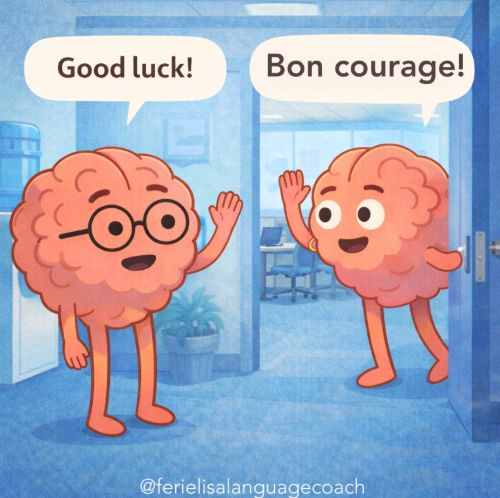
"Good luck" and "bon courage" carry the same intention: they send a colleague into something difficult with your support behind them. But they don't say the same thing. One invokes chance. The other calls on something the person already has.
I noticed this years ago, moving between English and French workplaces. When I said "bon courage" to a colleague heading into a tough meeting, it landed differently than "good luck" would have. Not better or worse. Just different. And when I started coaching professionals navigating both languages at work, I found this small gap creates real hesitation. Which one do you reach for? Does it actually matter?
Same intention. Different philosophy.
"Good luck" is warm, genuine, and widely used. But it leans on luck, on chance, on something external. You're wishing the person favourable circumstances.
"Bon courage" does something subtler. It doesn't wish for luck. It acknowledges the effort ahead, and trusts that the person has what it takes. The resources are internal. You're not hoping the stars align. You're saying: I see this is hard, and I believe you can do it.
This isn't a critique of "good luck". Native speakers use it constantly, and with full sincerity. But if you navigate both languages at work, it's worth understanding what each one carries.
How it plays out in practice
Here's the same scenario in both languages. A colleague is about to present to an important committee.
| 🇫🇷 French | 🇬🇧 English |
|---|---|
| Tu présentes le projet au comité cet après-midi ? | Big client presentation today, right? |
| Oui… un peu stressé, pour être honnête. | Yes… I've been preparing all week. |
| C'est normal. Tu es prêt. | I saw your slides. They're really clear. |
| J'espère que ça va bien se passer. | I hope the client likes the proposal. |
| Franchement, ton analyse est solide. | I'm sure they will. |
| Bon courage pour la présentation ! | Good luck with the meeting! |
| Merci, je te tiens au courant après. | Thanks! I'll let you know how it goes. |
Same warmth. Same support. But notice what's happening underneath.
In French, the lead-up already names the effort: tu es prêt, ton analyse est solide. The encouragement is grounded in what the person has already done. "Bon courage" is the natural extension of that recognition.
In English, the conversation is warmer and more observational: I saw your slides, they're really clear. "Good luck" wraps it up in a way that feels light and genuine, even if it technically hands the outcome to chance.
Both work beautifully in context. The difference is cultural, not hierarchical.
When luck has nothing to do with it

The distinction matters most when the outcome depends entirely on preparation, not chance. A presentation rehearsed for weeks. A negotiation planned carefully. A client call where you know your subject cold.
In those moments, "bon courage" feels more honest in French. It acknowledges the work already done, and the effort still ahead.
In English, "good luck" still lands warmly, and nobody will read anything into it. But if you want to match that same energy of I see your effort, I trust your ability, there are other phrases worth having in your toolkit:
- "You've got this." Direct, confident, no mention of luck.
- "Go get 'em." Energetic, informal, genuinely encouraging.
- "I know you'll nail it." Personal, grounded in your belief in the person rather than in circumstance.
- "You're ready for this." Calm, steady, acknowledges preparation.
None of these replace "good luck". They're just different tools. And knowing which one to reach for is part of navigating a bilingual professional world with real confidence.
The next time you switch between French and English at work, you don't need to overthink it. "Good luck" and "bon courage" both do the job. But if you want your words to carry exactly the right weight, knowing what's underneath them makes all the difference.
Do you say "good luck" often at work, or do you tend to reach for something else? I'd genuinely love to know what your go-to phrase is.
Frequently Asked Questions
Is "good luck" a direct translation of "bon courage"? Not quite. "Bon courage" is closer to "you've got this" or "hang in there" in terms of what it actually conveys. The more literal translation of "good luck" in French is "bonne chance", which exists but is used less often in professional contexts.
When should I use "bon courage" instead of "bonne chance" in French? Use "bon courage" when the outcome depends on the person's effort, not on chance. A difficult meeting, a long day ahead, a challenging task: those call for "bon courage". Reserve "bonne chance" for situations where luck genuinely plays a role, like an unpredictable outcome or something outside the person's control.
Are there other expressions in English that carry the same energy as "bon courage"? Yes. "You've got this", "hang in there", "I'm rooting for you", and "you're ready for this" all carry a similar sense of trust in the person's inner resources, without invoking luck. They tend to feel more personal and specific than "good luck".
Can a language coach help with professional bilingual communication? Yes. Navigating two languages at work goes beyond vocabulary. It includes tone, cultural expectations, and knowing how much weight a single phrase carries in context. Neurolanguage Coaching® works on exactly this kind of precision, so you can show up in both languages with confidence.
If this kind of nuance comes up regularly in your professional life, let's talk. Book your free discovery session here.