Biases shape how we judge the world, but also how we judge ourselves as language learners. Explore what the brain has to do with cognitive bias, how common biases affect language learning, and how coaching can help you respond differently.
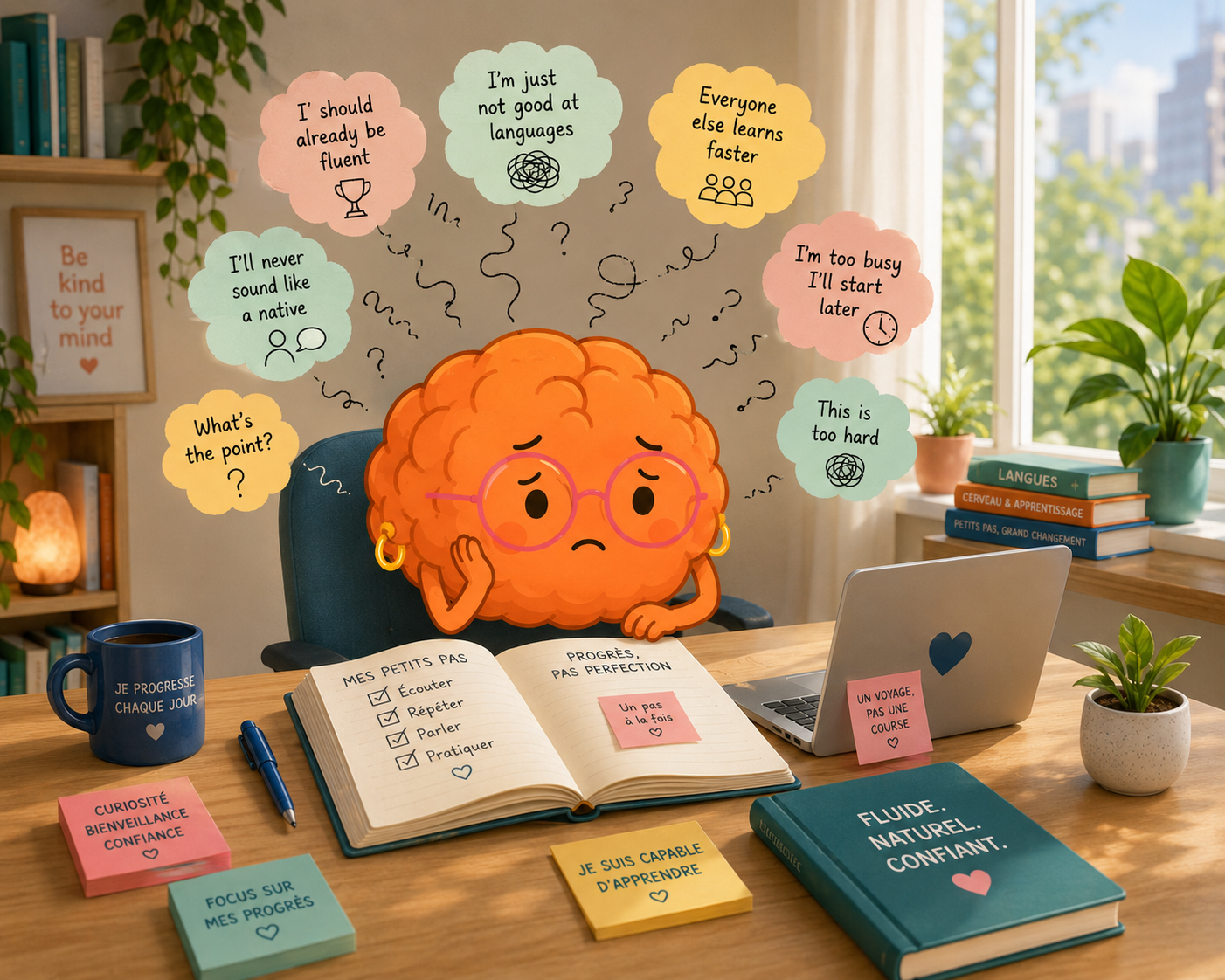
“I think unconscious bias is one of the hardest things to get at.”
— Ruth Bader Ginsburg
Did you know that your brain is constantly making assumptions and judgments based on your past experiences, beliefs, and the information around you?
We call many of these patterns biases. They affect how you perceive and interact with the world, but they can also affect something much closer to home: how you perceive yourself as a language learner.
That is where this gets interesting for me.
I originally explored biases in three newsletters, through the three lenses I use in my work: neuroscience, language learning, and coaching. I have brought those three parts together here because they make much more sense as one story.
First, what is the brain doing when biases form? Then, how can particular biases interfere with language learning? And finally, what can you actually do about them?
There are hundreds of named biases, so this is not going to be an encyclopedia (you are welcome). I have chosen the ones I find most relevant to the way we learn, communicate, judge our progress, and sometimes get in our own way.
Part 1: The brain, shortcuts, and bias
We live in a world where we have to make a lot of decisions all day, every day.
What socks to wear. What wine to drink. What Netflix series to watch. What playlist to choose. What podcast to listen to. You get the picture.
Meanwhile, your brain is already quite busy making you breathe, keeping your heart beating, monitoring what is happening around you, remembering what matters, ignoring what does not, and doing a few other mundane things like keeping you alive.
So we create shortcuts.
Psychologists often call these shortcuts heuristics. They help us make decisions and solve problems without stopping to analyze every possibility from scratch. Tversky and Kahneman famously described how these mental shortcuts help people make judgments under uncertainty, while also showing how they can produce systematic errors.
Heuristics exist for a reason. Without them, daily life would be exhausting.
The problem appears when we use a shortcut in a situation where more careful reasoning would help, or when our judgment is being shaped by information we have not consciously questioned.
That is when a useful shortcut can become a bias.
How does the brain contribute?
Our brains build networks of associations from repeated experiences. Information that appears together again and again becomes easier to connect. Previous experiences, social messages, cultural context, emotion, and memory all help shape the associations we carry with us.
This is one reason biases can feel so immediate. We do not always experience them as a long chain of reasoning. Sometimes a judgment simply feels obvious.
Neuroscience helps us understand parts of this process, although bias does not live in one single area of the brain. Research points instead to several interacting systems involved in social knowledge, emotional significance, attention, evaluation, and cognitive control.
The amygdala, for example, helps process emotionally significant and salient information. It can contribute to rapid evaluations, especially when something feels relevant, unfamiliar, or threatening. The prefrontal cortex and related control networks can help us slow down, evaluate competing information, and regulate an automatic response.
So I would not say, “your amygdala is biased and your prefrontal cortex fixes it.” The brain is more complicated than that (of course it is).
A better way to think about it is this: biases emerge from patterns of learning, emotion, memory, attention, and context, and more deliberate thinking can sometimes help us question those patterns.
Four common biases in everyday life
In my original research for this series, I discovered hundreds of biases. I picked a few of the more common ones because once you see them, you start spotting them everywhere.
Confirmation bias is our tendency to look for, interpret, favor, or remember information that supports what we already believe.
A manager might favor her preferred approach by listening more closely to supporting feedback and paying less attention to dissenting opinions. She may genuinely believe she has considered all the evidence while overlooking a better solution.
Negativity bias means that negative experiences or information can carry more weight than positive ones.
An employee might receive a largely positive performance review, then spend the rest of the day replaying the one critical comment from their supervisor.
In-group bias involves favoring people we perceive as belonging to our own group over people we perceive as belonging to another group.
Within a department, members of a close-knit social group may exchange information, support, or opportunities more easily among themselves, sometimes without consciously intending to exclude anyone.
The halo effect happens when a positive impression in one area influences our judgment in another.
An employee who excels in sales might receive so much recognition for that success that colleagues assume they must also be excellent at project management, leadership, or strategy, even when those skills have not actually been demonstrated.
These biases do not make us bad people. They make us human.
The more interesting question is what happens when the same mechanisms start shaping the way we learn.
Part 2: What biases can do to language learning
The human brain's tendency to form shortcuts and expectations can affect language learning on many different levels.
Some biases concern ourselves: what we believe we are capable of, how we interpret mistakes, and what we think our progress should look like.
Others concern languages, accents, countries, communication styles, and intercultural interactions. Those beliefs can influence who we listen to, what kind of English or French we consider "good," what we think fluency should sound like, and how comfortable we feel inhabiting another language.
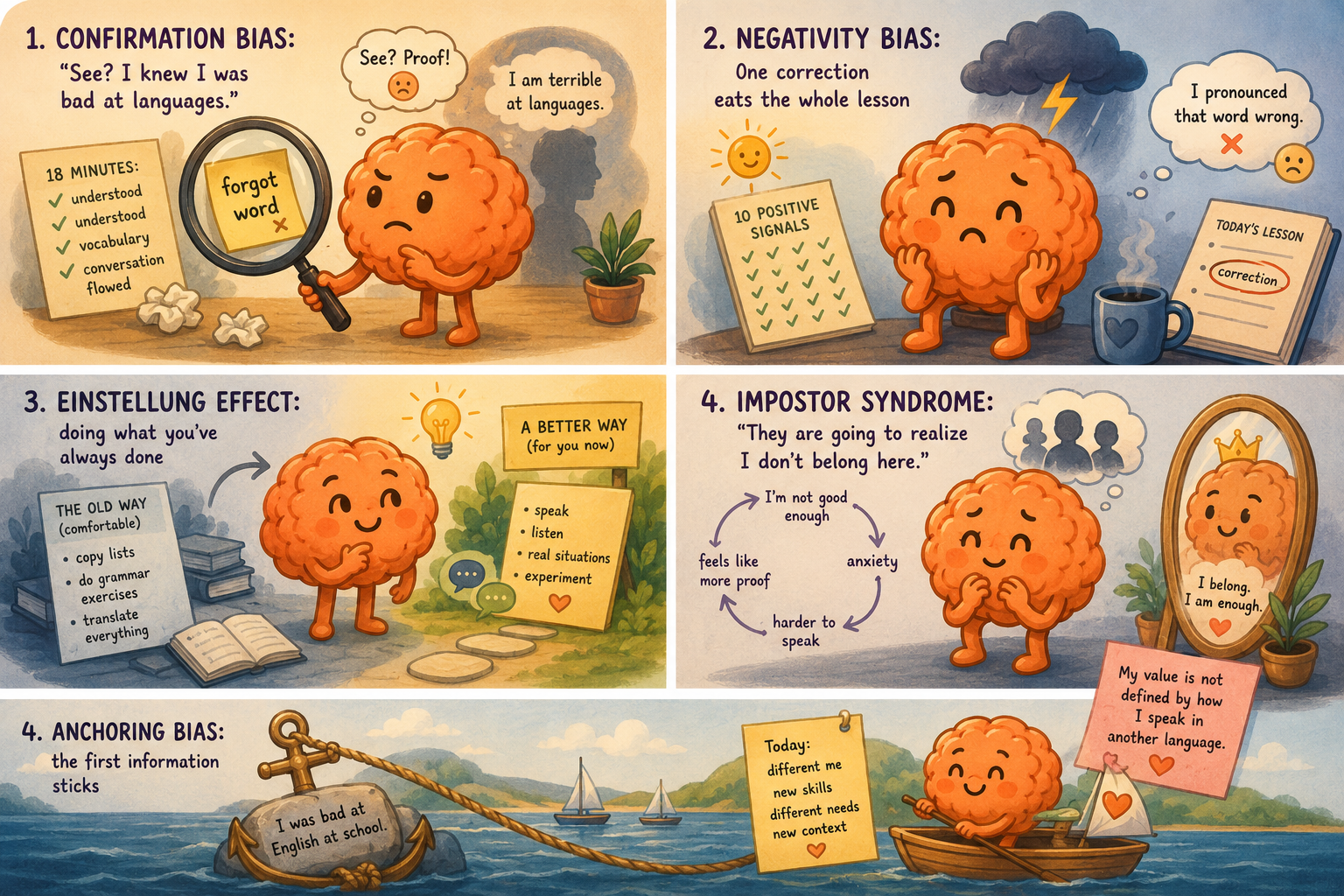
Here are five patterns I find particularly relevant.
Confirmation bias: “See? I knew I was bad at languages.”
Confirmation bias becomes especially powerful when it attaches itself to a belief about identity.
Imagine you already believe:
"I am terrible at speaking English."
You have a twenty-minute conversation. For eighteen minutes, communication works. You understand the other person, they understand you, you find the vocabulary you need, and the conversation moves forward.
Then you forget one word.
Guess which moment your brain may decide to keep as evidence?
The forgotten word confirms the belief you already had. The successful eighteen minutes do not feel important because they do not fit the story.
This is one of the reasons self-limiting beliefs can be so sticky. We are not simply repeating a thought. We may also be selectively collecting evidence for it.
Negativity bias: one correction eats the whole lesson
Negativity bias can make language feedback feel completely out of proportion.
A learner receives ten positive signals during a session and one correction. Later, what do they remember?
"I pronounced that word wrong."
Not: "I held a conversation for forty minutes."
Not: "I used vocabulary I could not access three months ago."
Not even: "I understood the joke."
The correction becomes the headline.
Of course, negative feedback matters. We need information about errors if we want to develop. The problem begins when one mistake becomes a judgment about your overall ability.
Einstellung effect: doing what you've always done
Einstellung is a German word for attitude or mindset. In psychology, the Einstellung effect describes the tendency to rely on a familiar strategy even when a better or more efficient solution is available.
For language learners, this one is everywhere.
Perhaps you spent years learning vocabulary by copying lists, so you keep copying lists even though you never use the words in conversation.
Perhaps grammar exercises made you successful at school, so you keep doing grammar exercises even though your actual goal is to speak more spontaneously in meetings.
Perhaps you translate every sentence into your first language because that was how you learned, even when the habit now slows you down.
Familiar does not always mean useful.
Sometimes language progress requires you to unlearn a strategy that once helped you and experiment with something that better matches the person you are now and the situations in which you actually need the language.
Impostor syndrome: “They are going to realize I don't belong here.”
This one is often called impostor syndrome, although the original psychological term is impostor phenomenon, and it is not technically classified as a cognitive bias.
I still include it here because it shows up so often in language coaching.
You may be perfectly competent in your professional role and suddenly feel much less competent when you have to perform that role in another language.
You know the subject. You have the experience. You've done the work.
And yet, in English, you start thinking:
"They are going to realize I am not as good as they think."
The language has not removed your expertise, but it can change your perception of that expertise.
When you struggle to find a word, you may interpret the pause as a sign that you are less intelligent, less credible, or less legitimate. That interpretation can then increase anxiety, which makes speaking harder, which feels like more proof that the original thought was right.
A very efficient little loop. Unfortunately.
Anchoring bias: the first information sticks
Anchoring bias happens when the first piece of information we receive has a disproportionate influence on what follows.
In language learning, your anchor might be a school grade from twenty years ago.
"I was bad at English at school."
It might be the first teacher who told you that you had a terrible accent.
It might be your first attempt to speak French in a restaurant, when you panicked, forgot everything, and switched back to English.
The first experience becomes a reference point. Years later, you may still be measuring yourself against it, even though your skills, context, motivation, and needs have completely changed.
That old anchor deserves to be questioned.
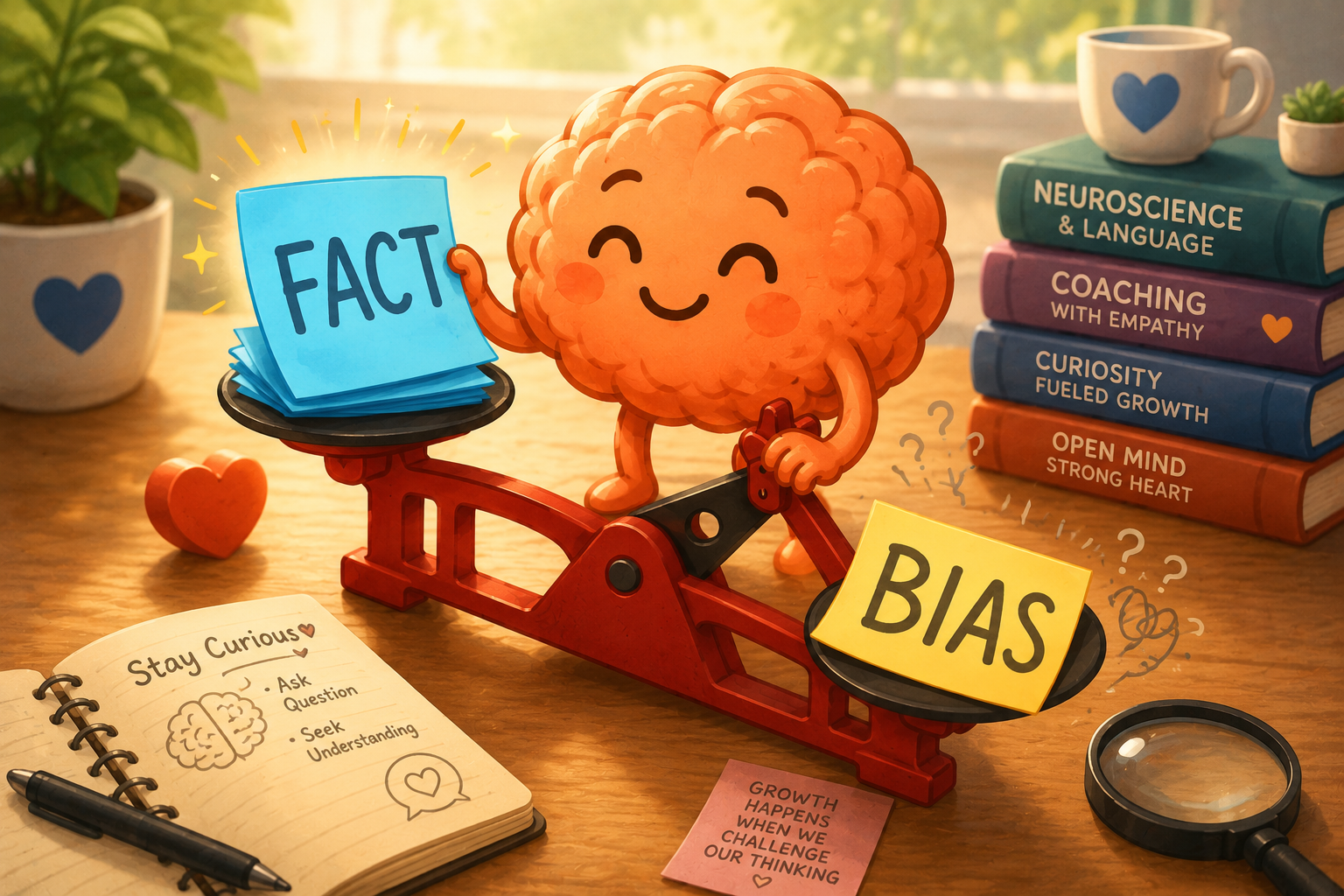
Part 3: Coaching, self-awareness, and what you can actually do
If you are reading this and recognizing yourself in one or two examples, you are already doing something useful: you are noticing the pattern.
Self-awareness matters because you cannot question a pattern you never notice.
At the same time, awareness alone does not magically erase bias. Research on interventions designed to change implicit measures suggests that effects can be modest and variable. Biases are often learned over time and reinforced by experience and context, so it makes sense that one moment of insight does not simply delete them.
I prefer to think of it this way:
Biases do not necessarily disappear, but you can become better at noticing them, questioning them, and choosing what you do next.
And yes, that takes practice.
Start with the foundations
Anything that supports your ability to regulate attention, stress, energy, and emotion can support the work you are doing as a learner.
That includes very ordinary things:
- Breathe and relax.
- Move your body regularly.
- Eat in a way that supports your health and energy.
- Stay connected to people who support you.
- Maintain a growth mindset.
- Prioritize sleep.
None of these will magically remove a cognitive bias. They simply give your brain better conditions in which to learn, reflect, and respond instead of reacting on autopilot.
Then the coaching work becomes more specific.
Self-reflection: identify where the bias enters the story
Take time to really think about your language learning journey.
Where do negative assumptions or self-perceptions get in the way?
You might ask yourself:
"Why am I not enjoying this?"
"Why does learning this language feel like a drag?"
"What exactly happens just before I decide I am not good at this?"
The aim is not to interrogate yourself for hours. It is to identify the moment where an experience becomes a conclusion.
Challenge negative self-talk
Go one step beyond reflection and zoom in on your internal dialogue.
When self-criticism appears, ask whether the thought is supported by reality.
"Everyone is going to laugh at my French."
Really?
Did everyone laugh the last time you ordered food in a restaurant? Did anyone laugh? Or did you hesitate, feel uncomfortable, and then turn that discomfort into a prediction about what other people thought?
This is where you start to reframe.
Not with fake positivity. I am not asking you to replace "My French is terrible" with "My French is absolutely perfect and I am amazing."
Your brain knows when you are lying to it.
A more useful reframe might be:
"I hesitated, but I communicated what I needed."
Or:
"I made mistakes, and the conversation still worked."
That gives your brain a more accurate story.
Celebrate achievements, especially the small ones
Language learners are often surprisingly good at moving the goalposts.
You remember a word you could never remember before? Well, I should know it by now.
You order your meal in French for the first time? Yes, but I made two mistakes.
You speak in an English meeting? Yes, but I was nervous.
Stop for a second.
Had you ever done that before?
Progress is not only the spectacular moment when you suddenly feel fluent. Progress is remembering the word. Asking the question. Staying in the language instead of switching back. Recovering after you lose your train of thought.
Your brain needs evidence that the new pattern exists. Help it notice.
Set realistic goals
Unrealistic expectations are excellent at producing self-doubt.
"I want to be fluent."
Fine. What does that mean this week?
A better question might be:
"What small thing could I achieve that would genuinely make me happy?"
Perhaps you want to introduce yourself without rehearsing every sentence.
Perhaps you want to ask one spontaneous question in your next meeting.
Perhaps you want to make a phone call without writing the whole conversation first.
Set yourself up for success. Achieve the thing. Notice that you achieved it. Then move on to the next thing.
This is how you gradually rewire the relationship you have with progress.
And last but not least: get support
Some of these steps sound simple on paper.
They are often much harder when you are inside the pattern.
Deeply ingrained beliefs can have a powerful effect on your language learning journey, and sometimes it is easier to challenge them when someone is there to help you notice what you are doing, ask better questions, and keep you accountable.
That is a big part of what I do as a Neurolanguage Coach®.
I do not simply "teach" you a language. I help you work with the language challenges, habits, beliefs, and biases that affect the way you learn and communicate.
Sometimes we need to work on vocabulary or grammar. Sometimes we need to prime your brain before a difficult conversation. Sometimes we need to challenge the belief that every hesitation means failure. Sometimes the work is helping you gradually inhabit English or French as yourself, rather than waiting for some imaginary perfect version of you to appear.
The real goal is not to become bias-free
Biases are part of human cognition. They are also shaped by our cultures, environments, experiences, and the people around us.
So the goal is not to reach a mythical state where you make perfectly objective decisions and never misjudge yourself again.
The goal is to create a little more space between an automatic thought and what you do with it.
When you notice "I am bad at languages," you can ask where that conclusion came from.
When one mistake dominates the whole session, you can deliberately look at the rest of the evidence.
When an old learning strategy stops working, you can experiment with another one.
When your first experience has become an anchor, you can ask whether it still deserves that much power.
Your brain creates shortcuts. You can also teach it new routes.
And that, for me, is where neuroscience, language learning, and coaching meet.
What is one belief about yourself as a language learner that might be worth questioning today?
Links and Ressources about Biases
If you'd like to explore how your own beliefs and learning habits affect the way you speak, contact me for a discovery session.