
We breathe thousands of times a day without thinking about it. Yet the way we breathe can influence our nervous system, our speech, and how we handle the stress of speaking another language. Let’s take a closer look.

“Breath is the bridge which connects life to consciousness, which unites your body to your thoughts.”
— Thich Nhat Hanh, The Miracle of Mindfulness
We breathe thousands of times a day.
That’s it. That’s all the reason I needed to start looking at the subject. I mean, something we do that often is bound to have repercussions on our body, our mind, our communication and, yes, our language learning and speaking.
Breathing is automatic, until it isn’t. Your body takes care of it without asking you to remember, yet you can also change it deliberately. That makes breathing one of those fascinating meeting points between what your nervous system does for you and what you can consciously influence.
So, let’s take a breath and look at what that means for the brain, for speech, and for those moments when another language suddenly seems to disappear from your head just when you need it most.
Breathing and your nervous system
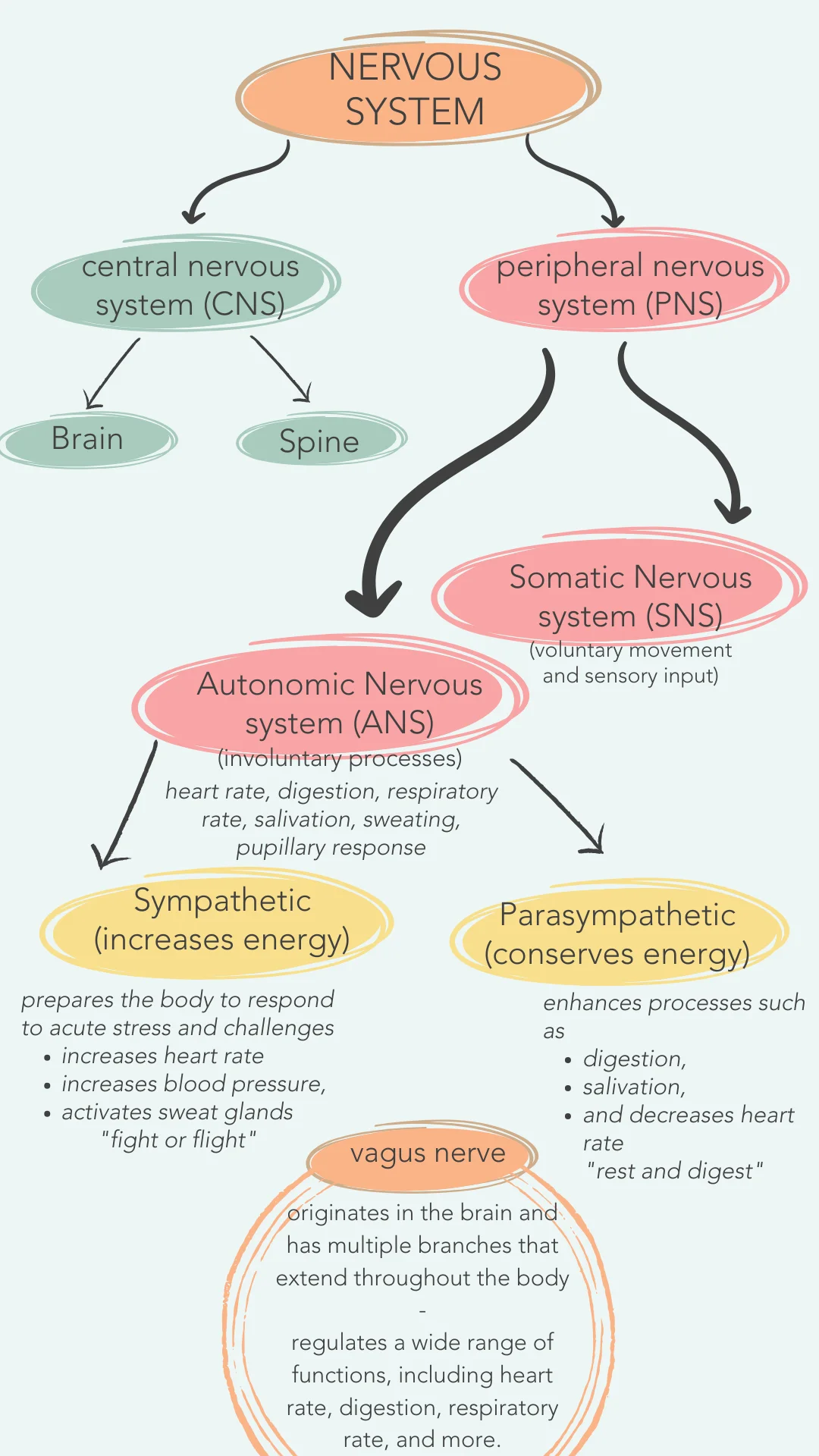
To understand why breathing matters, let’s start with a simplified view of the nervous system.
- Central Nervous System (CNS)
-
Includes the brain and spinal cord.
-
Peripheral Nervous System (PNS)
- Connects the CNS to the rest of the body.
-
Includes:
- The somatic nervous system
- Is involved in voluntary movement.
- The autonomic nervous system
- Helps regulate processes you don’t usually have to think about, including:
- Heart rate
- Digestion
- Breathing
-
The autonomic nervous system
- Includes two main branches:
- The sympathetic nervous system
- Helps mobilize you when you need to respond to a challenge.
- The parasympathetic nervous system
- Supports recovery, rest and regulation.
We need both.
The problem isn’t that the sympathetic nervous system exists. Thank goodness it does. The problem is when your body stays on high alert for too long, behaving as though something urgent is happening even when the “danger” is an overflowing inbox, a difficult meeting or the prospect of speaking English in front of twelve people.
This is where the breath becomes interesting.
Slow, voluntary breathing can influence autonomic regulation and is consistently associated with increases in vagally mediated heart-rate variability (HRV), one marker of parasympathetic cardiac activity. Research also shows that breathing and heart rate are closely coupled: heart rate tends to rise during inhalation and fall during exhalation.
The vagus nerve plays an important role in that conversation between the brain and the body. Rather than imagining one long exhale as a magic switch that simply “turns on” the vagus nerve, it’s more accurate to think of slow breathing as changing a whole cardiorespiratory rhythm in which vagal activity is involved.
And that matters because how you breathe isn’t completely outside your control.
You can’t decide to stop regulating your blood pressure for the afternoon. You can, however, notice that you’re holding your breath, breathing quickly, or barely letting your diaphragm move, and then change the pattern.
Don’t believe me? Breathe slowly and comfortably right now. Let your abdomen expand rather than lifting your shoulders. Exhale without forcing it.
See how different that feels from a second ago?
A common explanation is that deep breathing gives you more oxygen and therefore helps you focus. In a healthy person at rest, however, your blood oxygen is usually already well supplied. The benefits of slow breathing appear to be more about respiratory efficiency, carbon-dioxide balance, cardiorespiratory coupling and autonomic regulation than simply cramming more oxygen into your lungs.
That’s much more interesting anyway.
Breath or breathe?
Let’s begin with a tiny difference that causes a surprising amount of confusion.
- To breathe is the verb. The EA sounds like the EE in need: you need to breathe.
- The breath is the noun. The EA sounds like the EA in wealth: your breath is your wealth.
The spelling barely changes, but the pronunciation does.
And pronunciation isn’t only about producing the right sounds. It also depends on what you do with your breath.
When you speak or read aloud, you produce speech as you exhale. You need enough air to carry the sentence, but you also need to know where to pause, inhale, and begin again.
This can be difficult for French speakers reading English aloud.
In French, punctuation often gives you clear instructions about where to stop. You see a comma or a period, you pause, breathe, and continue.
English doesn’t always offer the same amount of punctuation. A sentence can look long on the page, with no comma arriving to rescue you. So a French speaker may try to read the entire sentence in one breath, speed up near the end, or run out of air before reaching the final word.
The solution isn’t to wait desperately for a comma. You need to learn to hear the natural pauses inside the sentence.
A natural pause can come:
- At the end of a group of words that carries one idea
- Before an important contrast
- Between two parts of a long sentence
- Before information you want to emphasize
- Wherever the listener needs a moment to absorb the meaning
Take this sentence:
When you speak English in an important meeting, you may know exactly what you want to say but still feel your breathing become faster.
You don’t have to read it in one heroic breath. You can divide it naturally:
When you speak English in an important meeting / you may know exactly what you want to say / but still feel your breathing become faster.
Those slashes aren’t punctuation. They show breath groups, small units of meaning that help your voice sound clearer and give you somewhere comfortable to breathe.
So when you read English aloud, don’t only look for commas and periods. Listen for meaning. Group the words together. Allow yourself to pause.
Your lungs will be grateful, and your listener probably will too.
So when you read aloud, don’t just pronounce the words. Listen to what the sentence is asking your breath to do.
A tiny reading-aloud experiment
Choose a short paragraph in your target language, around four to six sentences. It should be challenging enough to require attention, but not so difficult that you have to stop for every other word.
First, read it aloud without preparing it.
Notice:
- Where you run out of breath
- Where you speed up
- Where your voice becomes flat
- Where you pause only because you see punctuation
- Where the meaning naturally seems to shift
Then read the paragraph silently and mark the natural pauses with a slash:
When you speak English in an important meeting / you may know exactly what you want to say / but still feel your breathing become faster.
Now read it aloud again.
This time:
- Inhale comfortably before each new breath group
- Let the words flow on the exhale
- Pause at the slashes without rushing
- Keep the final words of each group clear
- Stop if you feel yourself forcing the breath
Finally, record yourself reading both versions.
Don’t listen for a “perfect accent.” Listen for something more useful:
- Does the second version sound calmer?
- Is the meaning easier to follow?
- Are the important words clearer?
- Do you sound less rushed?
- Does your breathing feel more comfortable?
Repeat the experiment with the same paragraph for three days. As the breath groups become more natural, remove some of the slashes and see whether your body has started to remember where the pauses belong.
You’re not only practicing pronunciation. You’re training your breath, rhythm, and meaning to work together.
Pauses, silence and the space between words
Breathing also connects to something we don’t talk about enough in language learning: silence.
A pause isn’t necessarily a failure to speak.
It can mark structure. It can create emphasis. It can give you time to think. It can signal that you haven’t finished your turn. It can also give you time to breathe.
And pauses don’t carry exactly the same social meaning in every context or culture. Research comparing conversational behavior across languages shows both strong human similarities in turn-taking and real differences in how silence, response timing and listener behavior are used.
That means part of becoming comfortable in another language is learning not only what people say, but how much space they leave around what they say.
This is where learners sometimes get themselves into trouble.
You may interpret every half-second of silence as I’m taking too long. They think my English is bad. I need to say something NOW.
So you rush.
And because you rush, you breathe less comfortably.
And because you’re breathing less comfortably, you rush some more.
Not the most helpful feedback loop.
Sometimes the best thing you can do in a conversation is simply allow yourself one breath.

Can you use your breath deliberately?
Yes, you can. In fact, you do it all the time.
Unfortunately, when you’re stressed, you often change your breathing without realizing it. Your breath becomes shallow, faster, or more irregular, and that pattern can continue for quite a while. Sometimes you even hold your breath for a few seconds without noticing.
Then you sigh.
That sigh isn’t random. It’s one of the ways your body resets the rhythm of your breathing and helps regulate what’s happening inside.
So the question isn’t really whether you can influence your breath. You already do. The question is whether you can learn to do it deliberately.
Controlled breathing simply means consciously changing the rate, depth, or pattern of your breathing. There are many methods, but one of the simplest is slow-paced breathing.
A commonly studied range is around five to six breaths per minute, although there isn’t one magical rate that works identically for everyone. In HRV biofeedback research, a person’s individual resonance frequency often falls somewhere around this range.
A simple version is:
- Inhale comfortably for about five seconds.
- Exhale comfortably for about five seconds.
- Continue for a few minutes without forcing the breath.
If five seconds feels uncomfortable, shorten it. The goal isn’t to win a breathing competition.
Slow breathing at this kind of pace has been associated with increased HRV and changes in baroreflex and autonomic regulation. Reviews also report reductions in measures of arousal and anxiety in many slow-breathing studies.
So, is the secret to everything taking back control of our breath?
OK, maybe not everything.
But could deliberately slowing your breathing help you regulate yourself before a difficult conversation, presentation, coaching session or language task? Yes, that’s a much more defensible claim.
What does this have to do with language coaching?
Quite a lot, actually.
Although I apply my coaching skills to language learning, I’m a coach, and I’m interested in what happens to the whole person who’s trying to communicate.
Someone can know the grammar and still freeze.
They can know the vocabulary and still rush through a presentation so quickly that nobody can follow them.
They can know exactly what they want to say and still spend the first five minutes of a meeting thinking, Please don’t ask me a question.
In those situations, working on the language alone may not be enough.
Breathing won’t teach you vocabulary. It won’t fix pronunciation by itself. It won’t make fear of judgment vanish after three slow exhales.
What it can do is give you a concrete way to prime your body for the communication you want to inhabit.
Before a meeting, slow your breathing for a few minutes. Inhale confidence, exhale doubt.
Before answering a difficult question, let yourself exhale instead of launching into the first sentence at full speed. Again, inhale Confidence, Exhale Doubt
When you’re reading aloud, notice where your breathing fights the rhythm of the language.
When anxiety starts turning every pause into evidence that you’re “bad at English,” reframe the pause. Maybe you aren’t stuck. Maybe you’re breathing, thinking, and giving your next sentence somewhere to land.
That’s a very different experience of speaking.
A one-week breathing experiment
Now that you know a little more about what your breath is doing, I challenge you to notice it for one week.
Not obsessively. You have other things to do.
Just catch yourself a few times during the day.
What happens to your breathing when you’re concentrating? When you’re stressed? When you speak English/French? When someone interrupts you? When you’re about to say something you’re not completely confident about?
Then experiment.
Slow the breath for a minute or two. Try a comfortable five-second inhale and five-second exhale. Read something aloud and notice where you naturally need air. During a conversation, allow yourself a pause without immediately trying to fill it.
And notice what changes.
Your mood? Your pace? Your voice? Your ability to retrieve words? Your willingness to leave a little silence in the room?
My friend and yoga teacher Elli Zisis created a five-minute breathing exercise to help you relax and reset. Not another page of theory, just five minutes to stop reading about breathing and actually breathe.
Enjoy every breath.
If you’d like to explore how your nervous system, confidence and communication habits interact when you speak another language, contact me for a discovery session.
Book a "Speak with Confidence" Session here
Links and Resources about the breath and the brain