
Arabic is a fascinating language I have a special relationship with. Here is a beginner's introduction to the language.
I have a special relationship with Arabic. I can read it and speak a dialect of it, but I can't write it or understand it very well (but I can communicate well enough if lost, or hungry, or need the bathroom!). It depends on where the speaker is from, what accent they have, what topic they are talking about, and so on.
Arabic is a fascinating language that I love to explore and share with others. I have more than just a passing interest in it; I have immersed myself in it several times.
This is the first blog post in a series about Arabic. In this post, I will try to explain some basic facts about the language. In a future post, I will tell you about my long and somewhat unsuccessful journey of trying to learn Arabic (spoiler: it's not because Arabic is hard).
Some basic facts about Arabic
- Arabic is a Semitic language that originated in the Arabian Peninsula
- It is spoken by over 300 million native speakers in over 20 countries, mostly in the Middle East and North Africa
- It is one of the oldest languages in the world and one of the six official languages of the United Nations
- There is Standard or Classical Arabic, which is the form of the language used in media, newspapers, literature and other formal settings
- Colloquial (spoken) Arabic has many forms that vary from country to country, and even town to town
- Arabic is written from right to left in a consonant alphabet of 28 letters
- Some letters change their shape depending on their position in a word
- Vowels are usually omitted or marked with diacritics
- Arabic is the language of the Qurʾān, studied by over one billion Muslims as a foreign or second language
- Arabic has more than 11 words for love, each with a different meaning and connotation. For example, hubb means 'seed' (implying potential for growth); ishq means 'passion'; gharam means 'longing'; mawadda means 'affection'
- Arabic is widely used in art through calligraphy : modern Arabic art now often blends calligraphy and graffiti, known as 'calligraffiti'
A beginner's look at Arabic grammar
I don't view languages as difficult in general. They are what they are. With Arabic in particular, being a language I've been familiar with my whole life, sentences make sense to me as they are.
Personal pronouns
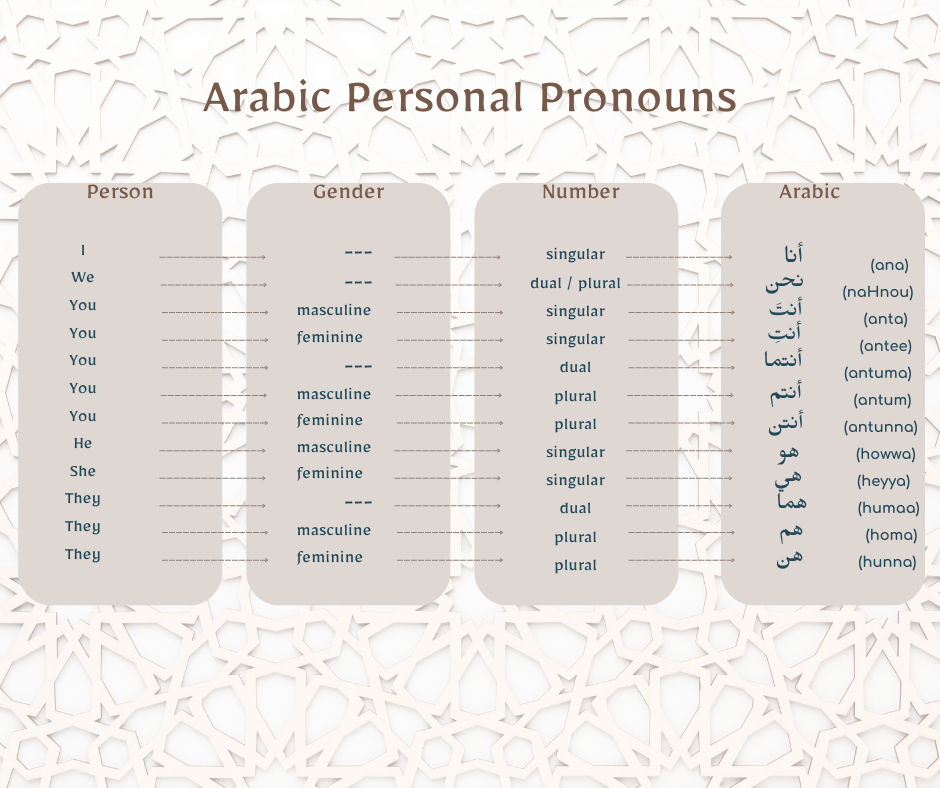
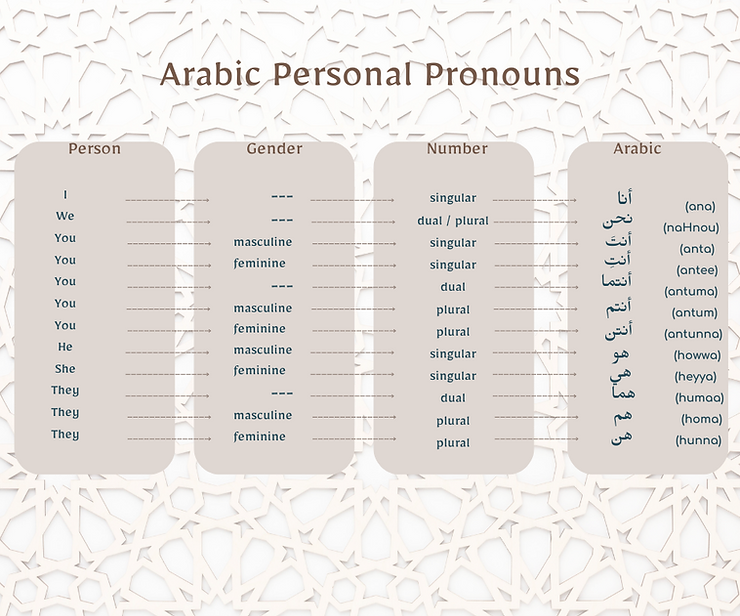
There are 12 personal pronouns in Arabic, which vary according to person (first, second, and third), gender (masculine and feminine), and number (singular, dual, and plural).
Trilateral roots
Arabic constructs words from basic roots. A pattern of three letters, such as k-t-b, will always be the foundation of words relating to 'writing':
| Arabic | Romanisation | English |
|---|---|---|
| كِتَاب | kitab | book |
| كِتَابَة | kitaba | writing, script |
| مَكْتَب | maktab | desk, office |
| مَكْتَبَة | maktaba | library |
Another example using j-m-ʿ:
| Arabic | Romanisation | English |
|---|---|---|
| جَمْع | jam' | gathering; collection |
| جُمْعَة | jum'a | Friday; congregation |
| جَمَاعَة | jama'a | group; community |
| مُجْتَمَع | mujtama' | assembly; society |
| جَامِع | jami' | mosque; gatherer |
Verb forms
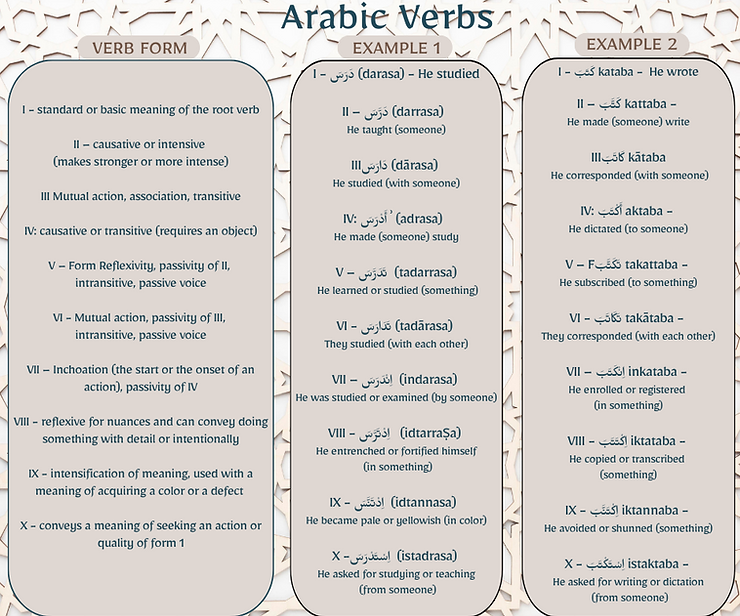
Each trilateral Arabic root can theoretically be transformed into one of ten possible verb forms (الأوزان, al-awzaan). Each form has a basic meaning associated with the root:
- Form 1 : expresses the general verbal meaning: درس (darasa) = to study
- Form 2 : built by doubling the middle radical: درّس (darrasa) = to teach
- Form 3 : adds alif between first and second radicals, expresses doing the act with someone else: دارس (dārasā) = to study with another person
And so on...
There are so many other things about the language I could share with you. But this article needs to end somewhere. This is plenty enough for a 101 Arabic lesson :-)
النهاية : The end
References: 1. Arabic Language: Facts & History - edarabia.com 2. BBC Languages - A Guide to Arabic 3. 5 Facts about the Arabic Language - Language Insight 4. A few surprising facts about the Arabic language - British Council 5. The Arabic verb forms - desert-sky.net