
The Challenger
Source: CP Enneagram Academy - The Ultimate Guide
Key Traits
- Anger and the Willingness to Confront. Of the three "anger types" at the top of the Enneagram, Eights, in contrast to Nines and Ones, usually have less resistance to confronting people, identifying their anger, and expressing aggressive feelings.
- Rebelliousness. The prototype of the revolutionary activist, Type Eights rebel in the sense that they don't easily acknowledge an authority above themselves.
- Punitiveness / Revenge. When Eights get hurt by others they may not allow themselves to fully register the pain of that hurt; feeling pain might mean experiencing their vulnerability, which Eights automatically avoid.
- Dominance. Naturally assertive and ready to show aggression when necessary, they can energetically dominate others even without consciously meaning to.
- Insensitivity. Eights can be perceived as insensitive. This characteristic grows out of their tendency to minimize the presence of softer, more vulnerable emotions like fear, hurt, and weakness.
- Autonomy. Not wanting to be seen as weak or to find themselves in a vulnerable position, Eights disavow their dependency on others.
- Sensory-Motor Dominance. Eights are firmly rooted in the physical, in the "here and now" sphere of the senses, and in a kinesthetic, body-based way of functioning.
Overview
Type Eight represents the archetype of the person who denies weakness and vulnerability by taking refuge in fearlessness, power, and strength.
Type Eights' have an automatic ego reaction opposing any limitations on their instinctual drives causing an auto-rebellion against the rules of society or established authority. Just as Type One represents the "anti-instinctual" force within the human personality, Type Eight represents the "pro-instinctual" force inside all of us.
The Type Eight personality is lusty, intense, energetic, and powerful. This "under-social" stance motivates rebellion against the restrictive authority of established authorities, rules and conventions. The Type Eight habit of mind motivates them to go up against external powers and limitations both as a way of asserting their control and as a way of combating oppression and protecting the weak.
As with all the archetypal personalities, however, Type Eights' gifts and strengths also reflect their "fatal flaw" or "Achilles heel." Their strength and power often represent overcompensation for not wanting to feel weak or own their vulnerable feelings.
Zooming In
Focus of Attention
Eights naturally focus their attention on power and control, who has it and who doesn't, and how it's wielded. They think in terms of the big picture and (mostly) dislike dealing with details. They see the world as being divided into "the strong" and "the weak," and they identify with "the strong" to avoid feeling weak.
Thoughts and Emotions
Emotionally, Eights usually have easy access to anger and (unconsciously) avoid registering vulnerable feelings. They typically appear fearless and can be intimidating to others, often without meaning to be. They like to be in control, engage in black and white thinking, and do not like to be told what to do.
Behavior Patterns
Eights have a lot of energy, can accomplish big things, can confront others when necessary, and will protect people they care about. They can be workaholics, taking on more and more without acknowledging their physical limits, and refuse to experience vulnerable feelings that might slow them down.
Blind Spots
- Their own weaknesses, vulnerability and vulnerable feelings
- Limitations to their power and strength, seeing cases where taking a softer approach may be more effective
- The negative effects of being too action-oriented
- How they intimidate others or pigeonhole others into "good or bad"
- Their impact on others, times when they apply too much pressure
When Blind Spots are Integrated
- Balance strength and power with an awareness of their own weaknesses; become softer and more approachable through sharing vulnerability
- Moderate their tendencies to dominate or control situations
- Take time to think and consult others before taking action
- Develop more empathy for others by accessing more of their own emotions
- Understand the impact they have on others
Passion : Lust
(dominant emotional drive, fixation, that each type struggles with)
The passion that drives Type Eight is lust. As the core emotional motivation behind this type, lust is excess, a passion for excess in all types of stimulation. For Eights, lust also implies an impatience or urgency to have their desires satisfied. They don't like to wait or negotiate or feel limited.
Virtue : Innocence
(higher emotional state, quality, that each type can achieve when healthy and balanced)
Innocence is the virtue that provides an antidote to the Type Eight passion of lust. In a state of innocence, this type becomes less guarded and aggressive and gains a new-found heart-based capacity to stay undefended. They trust that others, and they themselves, are inherently good, not bad. They no longer need to be in charge of everything or override life's natural rhythms.
The Path From Lust to Innocence
The Type Eight paradox is grounded in the polarity between the passion of lust and the virtue of innocence. This type must recognize the fear and sadness they hold within to transform. They must discover that their deeper emotions have been denied and hidden by lust. Innocence opposes lust by allowing Type Eights to respond in a fresh way to each moment, free of expectations or judgments.
Type Eight Subtypes
Self-Preservation Eight: Satisfaction
Self-Preservation Eights express the passion of lust through a focus on getting what they need for survival. SP Eights have a strong desire for the timely satisfaction of material needs and an intolerance for frustration. They are the least expressive and the most armed of the three Eight subtypes.
Social Eight: Solidarity (Countertype)
Social Eights express lust and aggression in the service of others. A social antisocial person, this is the countertype of the Eights, a helpful Eight who appears less aggressive and more loyal than the other two Eight subtypes. The name "Solidarity" emphasizes their tendency to offer help when people need protection.
Sexual Eight: Possession
Sexual Eights express lust through rebellion and the need to possess everyone's attention. Sexual Eights are intense, charismatic characters who want to have control and influence. "Possession" refers to an energetic takeover of the whole scene, a need to feel powerful through dominating the whole environment.
Growth Path
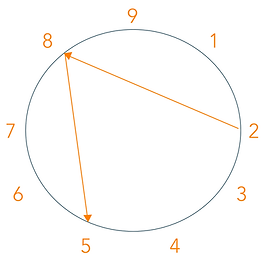
Moving back to Type 2
The path of growth for Type Eights calls for them to reclaim their ability to actively open up to their empathy for others and their need to be appreciated. Navigated consciously, Eights can use the move to Two developmentally to reestablish a healthy balance between attuning to others' feelings and needs and asserting their own needs. Moving back to Two can be a way for Eights to consciously re-engage a lost sense of their needs for comfort, love, and care.
Moving ahead to Type 5
The Inner Flow growth path for Type Eights brings them into direct contact with the challenges embodied in Type Five, allowing for a balance between withdrawal and forward momentum and between thinking and acting. The Eight working consciously in this way can make ready use of the tools healthy Fives use: analytical skills and economical use of energy and resources in support of self-protection and self-expression.
As Eights work on themselves and become more self-aware, they learn to escape the trap of limiting themselves through opposing limits on themselves by developing a clearer awareness of their softer side, tempering action with more thinking and feeling, and learning to moderate their impulses and impact.
Using the Enneagram for Growth
The first steps involve observing yourself to make the patterns and habits associated with your main, or "core," type more conscious. After you have done this for a while, you can create further growth shifts by using the arrows as pathways for growth.
- The point behind (moving back) our core type along the arrow lines represents issues from the past that we need to re-integrate.
- The point ahead (moving forward) of our core point represents key challenges we need to master to become more whole.