
Bilingual news and shares about the brain, languages and coaching
Newsletter 20 - Music
Newsletter 20 - Music
"Music gives a soul to the universe, Wings to the mind, Flight to the imagination, and life to everything."
Plato
First came music, then came language. Both are forms of communication that use sounds, symbols, and rules to convey meaning and emotion. They also share some common neural pathways and cognitive processes, such as memory, attention, and pattern recognition.
In this newsletter, we explore how music can assist you in learning a language and why that’s a good idea.
The 1st part of this newsletter,the N, was about music and the brain. Didn’t have time to read it? Here’s a quick overview :
-
Music has a positive impact on your happiness and well-being as it activates your brain's reward system and mood by releasing dopamine, serotonin, and oxytocin - the neurotransmitters associated with pleasure, happiness, and social bonding.
-
Listening to music can help you cope with feelings of loneliness, sadness, or worry, as music can evoke positive emotions and memories.
-
Listening to music can reduce cortisol levels and lower blood pressure, heart rate, and anxiety.
Music and learning
Research shows that music impacts learning positively in many different ways. Check this out :
-
Music can boost our cognitive abilities and learning performance
-
Music can help us retain and recall information better
-
Music very possibly improves our attention, focus, and motivation
-
Learning music can also assist us in processing and understanding complex information that has nothing to do with music
-
Learning music is amazing for neuroplasticity, the ability of our brain to rewire and adapt to new challenges and experiences
What about language learning specifically?
Well, if you’ve studied or are currently studying music, the science is pretty clear on how music can positively influence second language acquisition. Musical training can improve language skills, such as pronunciation, grammar, and vocabulary, by enhancing our auditory perception, phonological awareness, and syntactic processing.
How about those of us who haven’t studied music beyond what we did in school or a few piano lessons?
The good news is, music can help us overcome the psychological barriers (anxiety, fear, or boredom) that may hold us back from progressing in a language - whether we’ve studied music or not. The'affective filter hypothesis'suggests that low anxiety and high motivation are conducive to effective language learning, as they allow us to receive and process more input and output.
Learning is more effective when you’re relaxed, confident, and motivated, as you are more open and receptive to new information and feedback.Music can help you achieve this state of mind, by reducing stress, increasing enjoyment, and stimulating curiosity. Music can also make your learning more engaging and meaningful, by associating it with positive life experiences, such as travel, friendship, or culture.
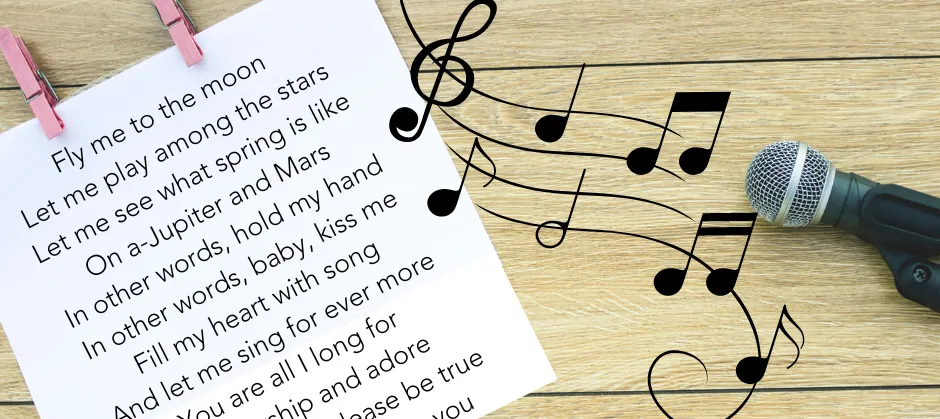
♫♫ Emmène-moi sur la lune et laisse-moi jouer parmi les étoiles. Fais-moi goûter le printemps sur Jupiter et Mars...♫ ♫
How can you use music to improve your Language?
There are 2 main ways you can do it. It’s not an “either/or” situation as both modes complete each other.
1) By listening to music in a focused mode
You can listen to music in your target language, and pay attention to the lyrics, melody, and rhythm.
You can read the lyrics, and note down any unfamiliar words, phrases, or expressions.
You can then look them up or ask someone who speaks the language fluently for help.
You can also compare the lyrics with their translation in your native language, and see how they differ in meaning, structure, or style.
Singing along to lyrics can be a really good way to practice your pronunciation, intonation, and fluency. Don’t worry, no one is listening to you 😉, belt it out !!
That’s how I learned Spanish once upon a time. There was a song I loved, I got the lyrics, sang along, learned them by heart (I was listening to it all the time), looked up the words, learned some verb tenses.I talk about in this video.
Still today, music is my first source for improving my Spanish. I might not have time to read and watch series (which I also do when I have the time), but I always have time to listen to music. Always.
2) By listening to music in a diffused mode
You can listen to music in the background while doing other language learning activities- such as reading, writing, or speaking -or any activity, learning or otherwise. Your brain will be learning, you just won’t know it.
You can choose music that matches your mood, goal, or level, and see how it affects your performance and attitude.
You can experiment with different genres, artists, or songs, and discover new sounds and styles that you like. Remember enjoyment is key.
You can use music to enhance your positive mindset, by choosing songs that inspire you, motivate you, or make you happy - after a stressful meeting in English for example, you could listen to a song (in English) to associate the language with positive feelings.
I’m aware of the fact that not everyone can do the whole “background music” thing. But I know that when I’m tired, I have no energy and procrastination is seriously in the air, I listen to music that makes me happy and gives me energy. I try to choose something in a language I’m trying to learn. Or not! -If you live in France and have Deezer for listening to music you canlisten to what I listen to here
On Android you can tryLyricstrainingto have fun learning languages through music.
On the Apple Store there’sLiricaandUnivoice, but I haven’t tried them.
If you're curious about my sources or want to know more about the neuroscience of music,you should click here
And if you want to go back on my past newsletters that cover all kinds of brain related, language related, coaching related fascinating subjects, I suggest yougo to my newsletters webpage
Links & Resources
Newsletter 20 — Links and Ressources about Music and the ...