Bilingual news and shares about the brain, languages and coaching
Newsletter 22- Habits

Newsletter 22- Habits
"We are what we repeatedly do"
Aristotle
I’m digging and digging. Deeper and deeper into the brain. This week, I got all the way into the Basal Ganglia and more precisely to your striatum.
Your habits - good or bad - or lack thereof - have a lot to do with your Striatum.
Follow me!
What are habits and why do we have them?
Habits are actions or behaviors that we perform automatically and repeatedly, without much conscious thought or effort.
Repeated behaviors reinforce neural pathways in the brain. Each time we perform a habit, neurons fire in specific sequences, solidifying the connections between them. This process not only makes the behavior more automatic but also reflects the brain’s remarkable capacity to adapt and rewire itself, we call thisneuroplasticity. This process not only makes the behavior more automatic but also reflects the brain’s dedicated effort to transform repeated actions into automatic habits.
Studies suggest that over 40% of our daily actions are based on habit.
Habits allow us to perform routine tasks with minimal cognitive effort so that our brain doesn’t need to '“waste” energy it needs for the 60% remaining daily actions we need to take. Indeed, by relying on habits, we reduce the mental load associated with making choices. When faced with countless decisions throughout the day, having established habits frees up brain resources for more critical matters than tying our shoelaces or brushing our teeth - or even driving home from work.
How do habits form in the brain and what role does dopamine play?
To understand how habits form in the brain, we need to take a look at a network of brain structures located in the center of the brain, called thebasal ganglia. The basal ganglia play a key role in managing muscle movement, learning and emotional processing, ensuring smooth communication between different brain areas, and are central to forming habits.
One of the structures of the basal ganglia is thestriatum, which reinforces learning and underlies automatic behaviors. The striatum is connected to theprefrontal cortex PFC- associated with planning complex cognitive behavior and decision making - via thecorticostriatal pathway.
In the context of habits, the connections between the cortex and striatum rely heavily on the neurotransmitterdopamine. When we engage in a rewarding behavior, in this case a habit with a positive outcome, dopamine is released, reinforcing the corticostriatal pathway.
Initially, the behavior is controlled by the PFC through active decision-making and conscious effort. Over time, as the habit forms, control over the behavior shifts to the striatum. The striatum now primarily controls the behavior, reducing the need for constant input from the cortex. This means our behavior is now more independently guided by the striatum, without heavy reliance on the cortex for input.
Why are you telling me so much about the brain Feriel?
Because the more you know about your brain and realize that it’smalleable and adaptable, the better you’ll be able to take control of your actions and thoughts.
Of course, the mechanism is much more complex - this is super condensed - and we don’t yet know everything there is to know about habits (also closely linked to addictions), research on the subject is still very active, but even knowing thisbasic framework can empower you to make positive changes.
Cue-Craving-Routine-Reward loop
At the core of habit formation lies a simple yet powerful neurological process known as the habit loop:
-
Thecuetriggers the brain to initiate a behavior: a time of day, a location, a smell, a person, a sound, an emotional state, an event.
-
Thecravingis the strong desire or urge for a specific activity, substance, or experience.
-
Theroutineis the behavior itself, performed in response to the cue.
-
Therewardis the benefit or satisfaction derived from the routine - reinforcing the habit
Over time, as this loop is repeated, the brain becomes more efficient at this process, effectively solidifying the habit - remember, neuroplasticity.
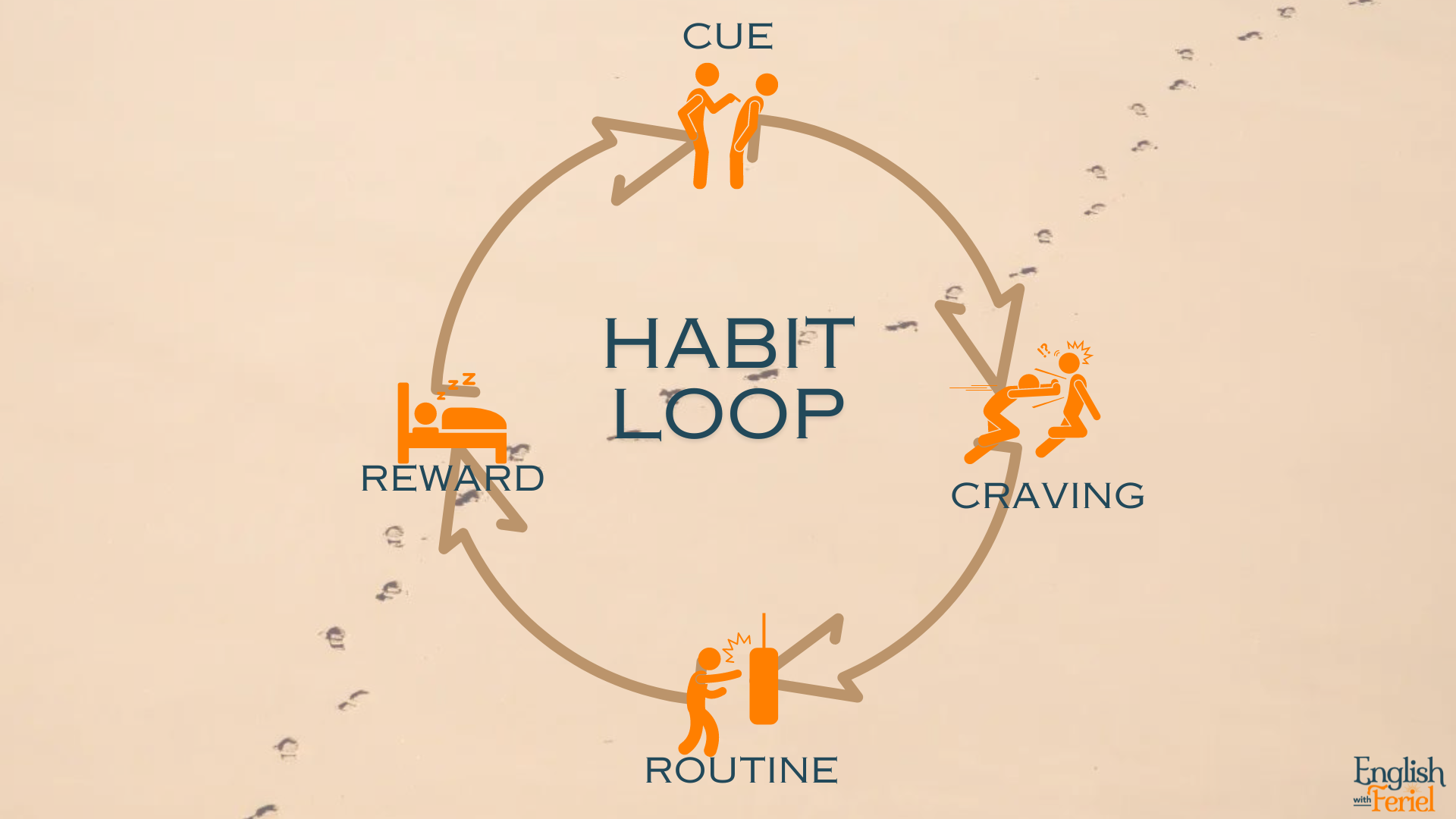
This would be a habit if it’s something you normally do. Every time you’re frustrated at work you go to the gym:
-
Cue:Your boss peaks badly to you
-
Craving: Tell him to shut up or worse
-
Routine:Going to the gym to beat up a punching ball instead
-
Reward:You got it out of your system, you can chill and have a great night
The following example is less thought of as a habit…but it is, and borders on addiction:
-
Cue: seeing your phone lying nearby
-
Craving: desire for novelty, connection, or information. You crave the satisfaction that comes from checking your phone.
-
Response: picking up the phone, unlocking it, and scrolling through notifications, messages, or social media.
-
Reward: dopamine release - the brain’s pleasure center gets activated from seeing or hearing something on the phone, reinforcing the behavior.
How does this apply to language learning? If you know how habits work and how your brain creates them, you can more easily implement new habits in your life…new learning habits :-) We’ll talk a bit more about that in Part 2 of this newsletter next week.
Ready? Set a new habit! Go!
If you want to know more about the neuroscience of habits,you should click here
And if you want to go back on my past newsletters that cover all kinds of brain related, language related, coaching related fascinating subjects, I suggest yougo to my newsletters webpage
Links & Resources